FedEx’s 2027 General Rate Increase: Why the 5.9% Headline May Understate Your Actual Cost Increase
FedEx has announced that standard list rates for U.S., U.S. export and U.S. import package services will increase an average of 5.9% effective January 4, 2027.
It is the same headline increase FedEx has implemented each year since 2024. It is also only an average, and does not help companies project how their actual shipping costs will change in the coming year.
Individual transportation rates and common surcharges are increasing by different amounts, with many exceeding the announced average. Some of the charges that can have the greatest effect on a shipper’s total cost are rising by 7% to 9.1%. FedEx is also adding fees, expanding the application of its Residential Delivery Charge and changing the zone classification for select ZIP-code pairs.
For shippers developing 2027 budgets, adding 5.9% to current FedEx spending will not produce a reliable forecast – here’s what will:
Base Rates Are Only One Part of the Increase
FedEx Ground rates for Zones 2–8 will increase an average of approximately 6.1%, based on an unweighted comparison of published rates across zones and weights. That already exceeds the announced 5.9% average before residential, delivery-area, handling, oversize, fuel or other applicable charges are added.
The actual increase for an individual shipper will depend on its service mix, billed weight, zones, destinations, package characteristics and contract terms.
A shipper with a high concentration of residential packages, for example, may experience a different increase than a B2B shipper using similar services. A company shipping large or irregular packages may encounter another result entirely.
Several Common FedEx Surcharges Are Rising Faster Than 5.9%
Among the more consequential changes:
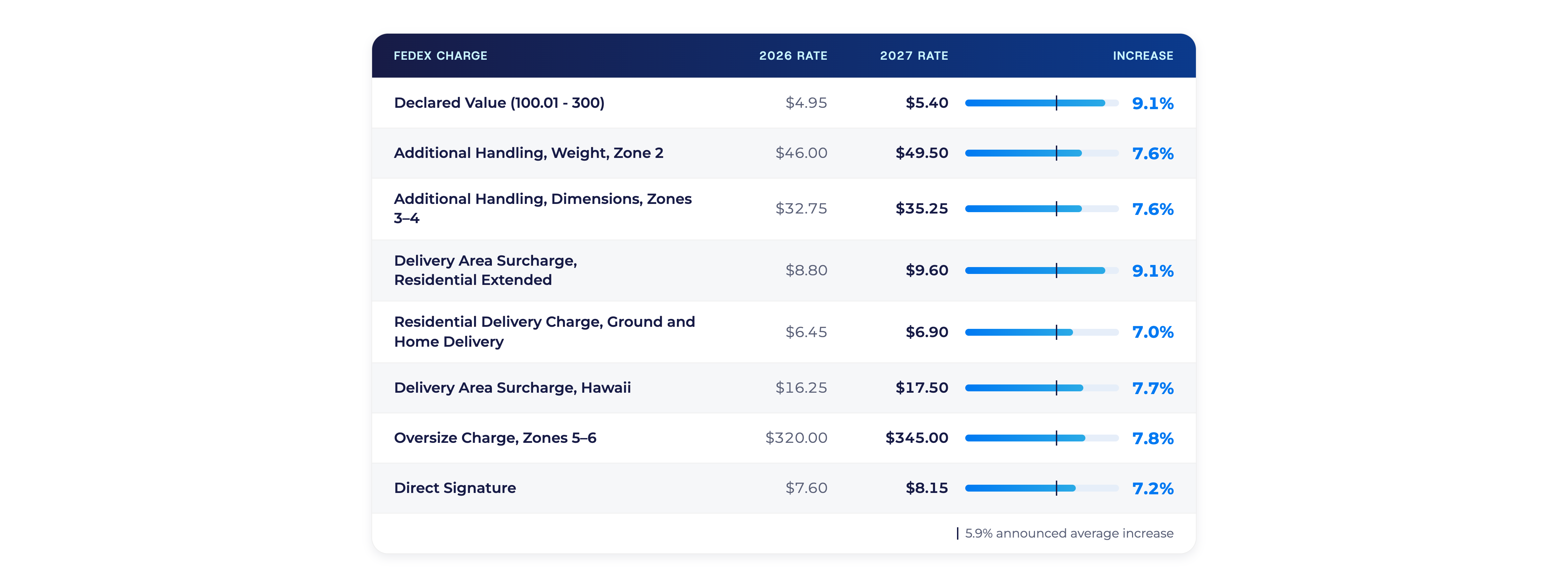
Additional Handling increases vary by trigger and zone. Weight-based charges rise between 7.1% and 7.6%; dimensional charges increase between 7.1% and 7.6%; and packaging-related charges increase between 6.8% and 7.5%.
Oversize increases also vary by zone. The charge rises 5.9% in Zone 2, 5.5% in Zones 3–4, 7.8% in Zones 5–6 and 7.6% in Zone 7 and above.
This variation matters because the packages receiving the largest per-piece charges can also be the packages experiencing the highest percentage increases.
Residential and Delivery-Area Exposure Deserves Particular Attention
FedEx Ground and Home Delivery residential surcharges will increase from $6.45 to $6.90, a 7% change.
Delivery Area Surcharges vary more widely. Residential Extended charges increase from $8.80 to $9.60, or 9.1%. Commercial Extended charges rise from $5.55 to $6.00, an 8.1% increase.
FedEx will also update its Delivery Area Surcharge ZIP-code lists effective January 4. A shipper’s cost may therefore change for two separate reasons:
- The surcharge applied to a qualifying shipment is increasing.
- Changes to the ZIP-code lists may alter which shipments qualify.
Companies should compare the new ZIP-code lists with their actual destination data rather than relying solely on last year’s delivery-area spend.
The Charges Can Accumulate on the Same Shipment
A 5.9% general rate increase and a 9.1% surcharge increase should not simply be added together. They apply to different components of the shipment cost.
They can, however, affect the same package.
A residential Ground shipment could be subject to a higher transportation rate, Residential Delivery Charge, Delivery Area Surcharge and fuel surcharge. If the package also qualifies for Additional Handling or Oversize, the applicable nonstandard charge can further increase its cost.
The result is a total increase driven by multiple interacting changes, not one uniform percentage.
Contract language then determines how much of that gross increase reaches the invoice. Transportation discounts may not apply to surcharges. Existing surcharge discounts, caps, waivers and exclusions may provide uneven protection. Minimum charges can also limit the value of an otherwise strong transportation discount, particularly as FedEx increases its published minimum package rates for 2027.
That is why a company’s historical invoice spend cannot be converted into a useful 2027 budget by multiplying it by 1.059.
FedEx Is Also Introducing New Fees and Rules
Several additional changes take effect after the January 4 rate increase.
Beginning January 18, 2027:
- A new $25 Paper Document Fee will apply when an associated trade document is submitted in a nonelectronic format and requires manual processing.
- A new $5 Paper Air Waybill Fee will apply to U.S. domestic and export shipments initiated with manual paper airbills.
- The Residential Delivery Charge will expand to qualifying international package and express freight shipments to select destination countries.
- All qualifying international shipments to the U.S. and Canada will become subject to the Residential Delivery Charge.
FedEx has said it will publish the additional destination-country list at a later date.
Beginning February 1, 2027, FedEx will also change the zone classification for select U.S. domestic origin-destination ZIP-code pairs. Those changes may affect transportation rates and zone-based surcharges even when a shipper’s distribution network remains unchanged.
How Shippers Should Build Their 2027 FedEx Budget
The most reliable approach is to re-rate actual shipment history under the 2027 rates and rules.
That analysis should identify:
- The gross increase before contract protections
- The net increase after applicable discounts, caps, and waivers
- Exposure to residential, delivery-area, handling and oversize charges
- Services, zones, package types and destinations driving the greatest change
- The effect of revised ZIP-code classifications
- International shipments that may become subject to Residential Delivery Charges
- Contract provisions that should be prioritized in the next negotiation
- The shipments most affected by increases to published and contractual minimum charges
The analysis should also separate true carrier inflation from changes caused by shipment growth, service mix, zone mix or package characteristics. Otherwise, companies may attribute an operational or customer-mix change to the GRI, or underestimate the carrier-driven increase hidden inside a changing shipment profile.
What Shippers Can Do Before January 4
Once the largest cost drivers are identified, shippers may still have time to act.
Potential responses include correcting packaging that repeatedly triggers Additional Handling, evaluating service substitutions, modifying routing rules, positioning inventory closer to customers, reducing avoidable paper processing and requesting targeted carrier concessions.
The right response will depend on where the exposure sits. A shipper with concentrated Oversize costs needs a different plan than one affected primarily by residential and extended-area deliveries.
FedEx’s 5.9% announcement is therefore a starting point, not a budget.
LJM can apply the 2027 FedEx rates, surcharges and rules to your actual shipment data and carrier agreement. The resulting analysis identifies your projected increase, the shipments driving it and the operational or contractual actions that may reduce the impact.
SCHEDULE A FREE 2027 SHIPPING CONSULTATION
Review the complete changes on FedEx’s official rate-change page.
Access This Content
Change the Economics of Your Shipping
Better Rates.
Complete Visibility.
Strategic Edge.


