UPS 2026 U.S. Domestic Peak Demand Surcharges: Complete Rates, 2025 Comparison and What Shippers Should Watch
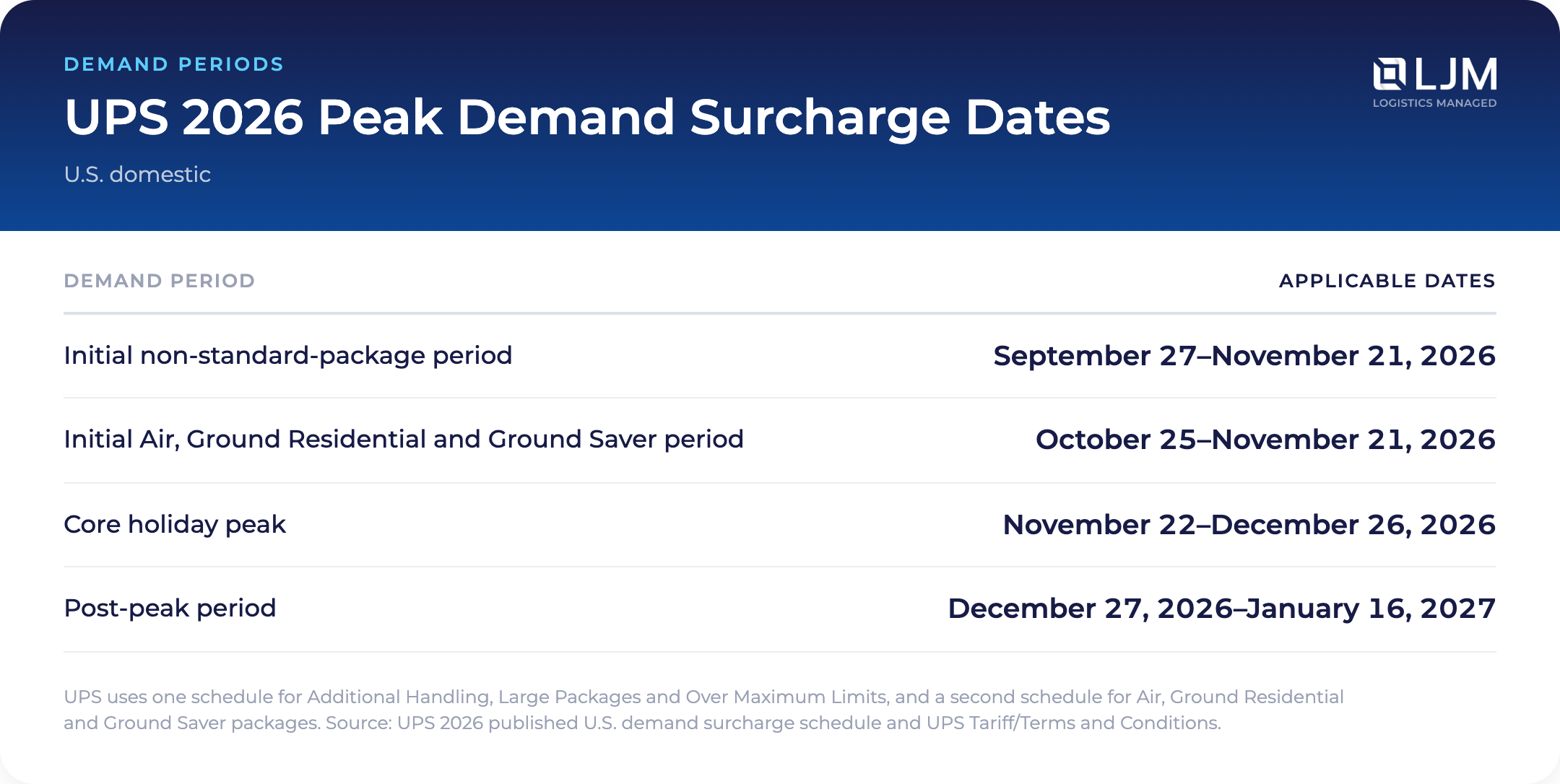
UPS has released its 2026 U.S. peak demand surcharge schedule, with the first charges taking effect September 27, 2026, and continuing through January 16, 2027. UPS's published schedule covers U.S. domestic shipments and separates peak pricing into three categories: non-standard packages, fixed demand charges by service level, and a volume-based schedule for qualifying higher-volume shippers. UPS notes that surcharge amounts and demand periods are subject to change.
NOTE: UPS separately publishes Surge Emergency Fees for certain international shipments and services. This article focuses on UPS’s 2026 U.S. domestic Demand Surcharges.
Every comparable rate in UPS’s published U.S. demand surcharge increased from 2025. The fixed per-package charges for UPS Ground Residential and UPS Ground Saver increased 25%, while the fixed Air surcharge rose approximately 22% to 23%. The highest dollar charges remain concentrated in packages requiring Additional Handling, Large Packages and packages that exceed UPS's maximum limits.
For many enterprise shippers, however, the most consequential provision is the higher-volume formula. Once a customer meets UPS's 20,000-package qualifying-volume threshold, the applicable surcharge is calculated each week by service level relative to a baseline. The highest applicable tier is then assessed on every package in that service level for the week, not only the packages above the threshold.
We break down everything you need to know about UPS’s peak season demand surcharges below.
Key Takeaways
- Every comparable UPS demand surcharge increased for 2026.
- Fixed UPS Ground Residential and UPS Ground Saver demand charges increased 25% year over year.
- Fixed UPS Air demand charges increased 22.0% to 22.7%, depending on the period.
- The core-peak demand surcharge reaches $11.90 for Additional Handling, $117.50 for Large Packages and $590 for packages that exceed UPS's maximum limits.
- Higher-volume Ground surcharges reach $8.00 per package, while higher-volume Air Residential surcharges reach $9.35 per package.
- UPS's baseline definition and the terms of each shipper's agreement determine actual exposure.
UPS 2026 Peak Demand Surcharge Dates
UPS uses one schedule for Additional Handling, Large Packages and Over Maximum Limits, and a second schedule for Air, Ground Residential and Ground Saver packages.
UPS 2026 Demand Surcharges for Additional Handling, Large Packages and Over Maximum Limits
The following demand charges apply to qualifying U.S. domestic packages. UPS states that they apply in addition to all other applicable charges.
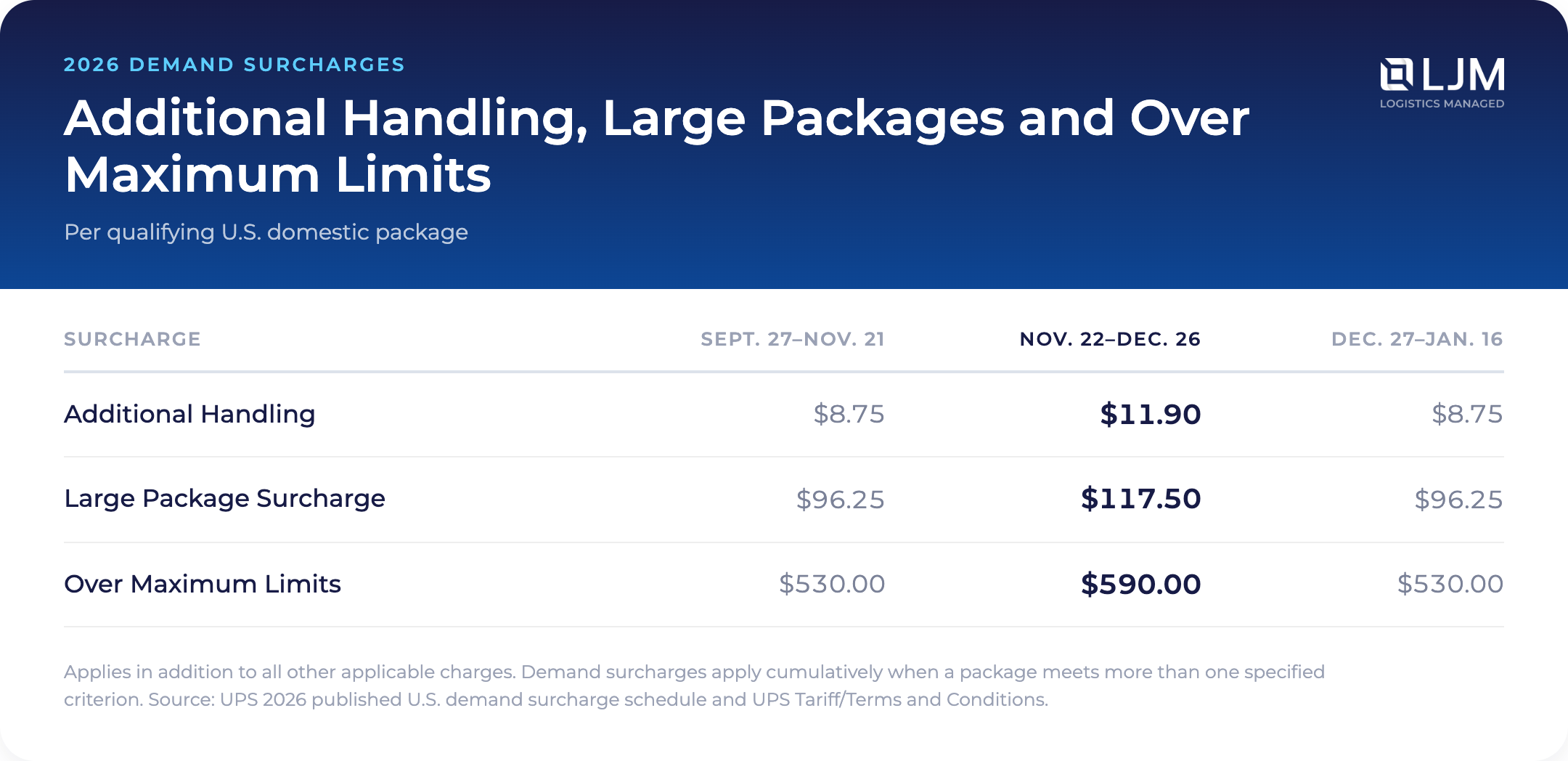
These are seasonal add-ons, not replacements for the underlying Additional Handling, Large Package or Over Maximum charge. A package that triggers one of these categories can therefore carry the ordinary accessorial charge, the demand surcharge, transportation charges, fuel and other applicable fees.
UPS's tariff also states that demand surcharges apply cumulatively when a package meets more than one specified criterion. It further states that no waiver, discount or reduction applies unless UPS agrees to it in writing with specific reference to the demand surcharge. See UPS Tariff Terms and Conditions for more information.
UPS 2026 Fixed Demand Surcharges for Air, Ground Residential and Ground Saver
For customers that are not subject to the higher-volume schedule, UPS applies the following per-package demand charges.
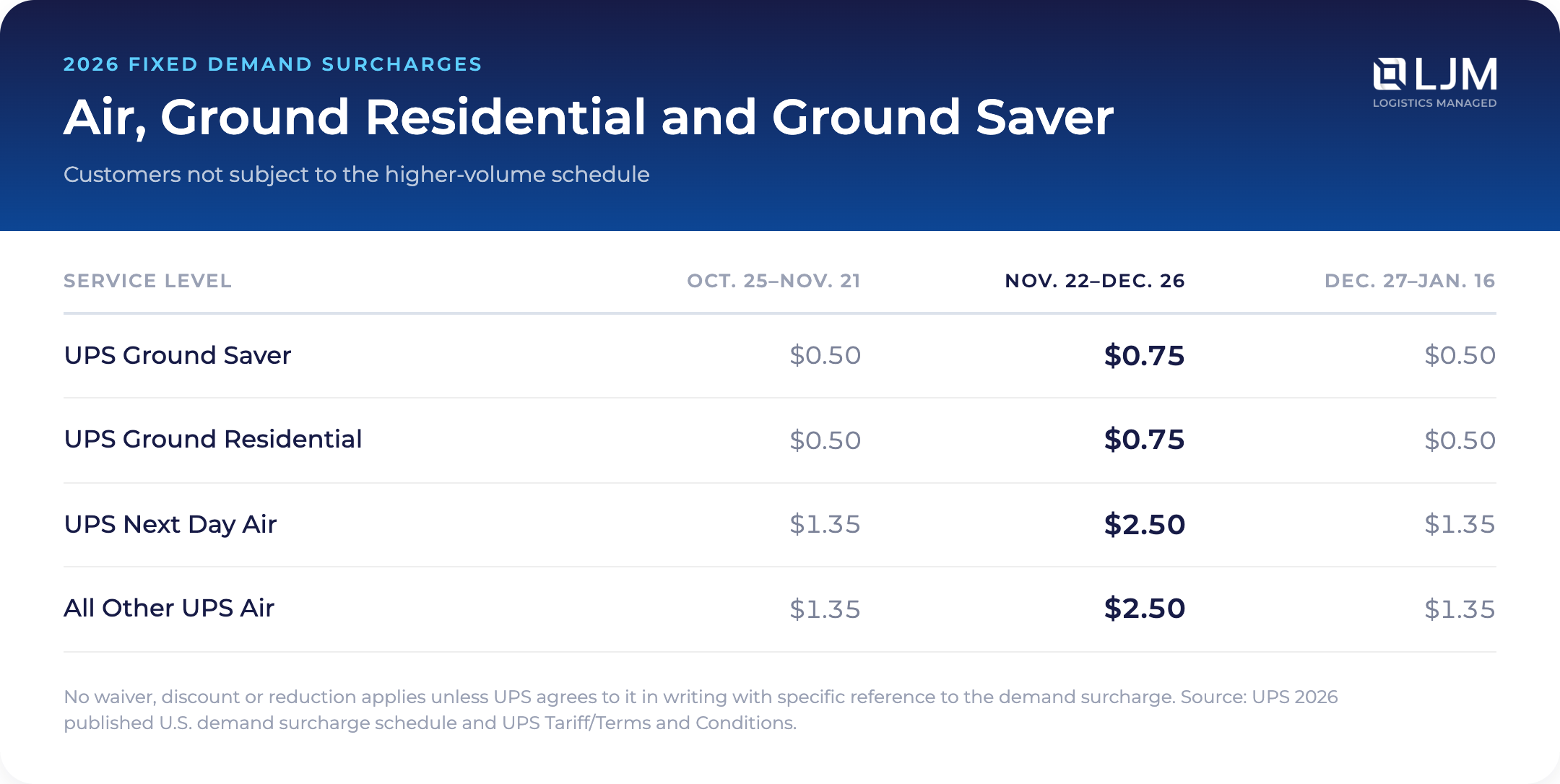
UPS defines All Other UPS Air as UPS 2nd Day Air A.M., UPS 2nd Day Air and UPS 3 Day Select. UPS Ground Saver was formerly known as UPS SurePost.
How the Higher-Volume UPS Demand Surcharge Works
The higher-volume schedule applies to customers whose combined volume of UPS Ground Residential, Ground Saver, Next Day Air Residential and All Other Air Residential packages exceeded 20,000 packages in any week after October 2025. The threshold is based on aggregate qualifying volume, regardless of how many packages moved within an individual service level.
Once the threshold has been met, UPS states that the higher-volume schedule applies until further notice. Each week, UPS compares volume within each service level with that service level's baseline and applies the highest applicable tier to every package in that service level for the weekly invoice period. UPS also provides an adjustment for holiday weeks that are not full UPS operating weeks, so shippers should account for shortened operating weeks when modeling the higher-volume charge.
The 2026 baseline is generally the customer's average weekly volume for the applicable service level from May 31 through June 27, 2026. If the customer's average weekly volume from August 30 through September 26 is less than 80% of the June average, UPS will use the later, lower average as the baseline. That provision can make it easier for a temporary holiday increase to produce a higher peaking factor.
2026 Higher-Volume Residential Surcharge Tiers
The following rates apply once weekly volume exceeds 105% of baseline. At 0% to 105%, the applicable fixed rate for that demand period remains in effect.
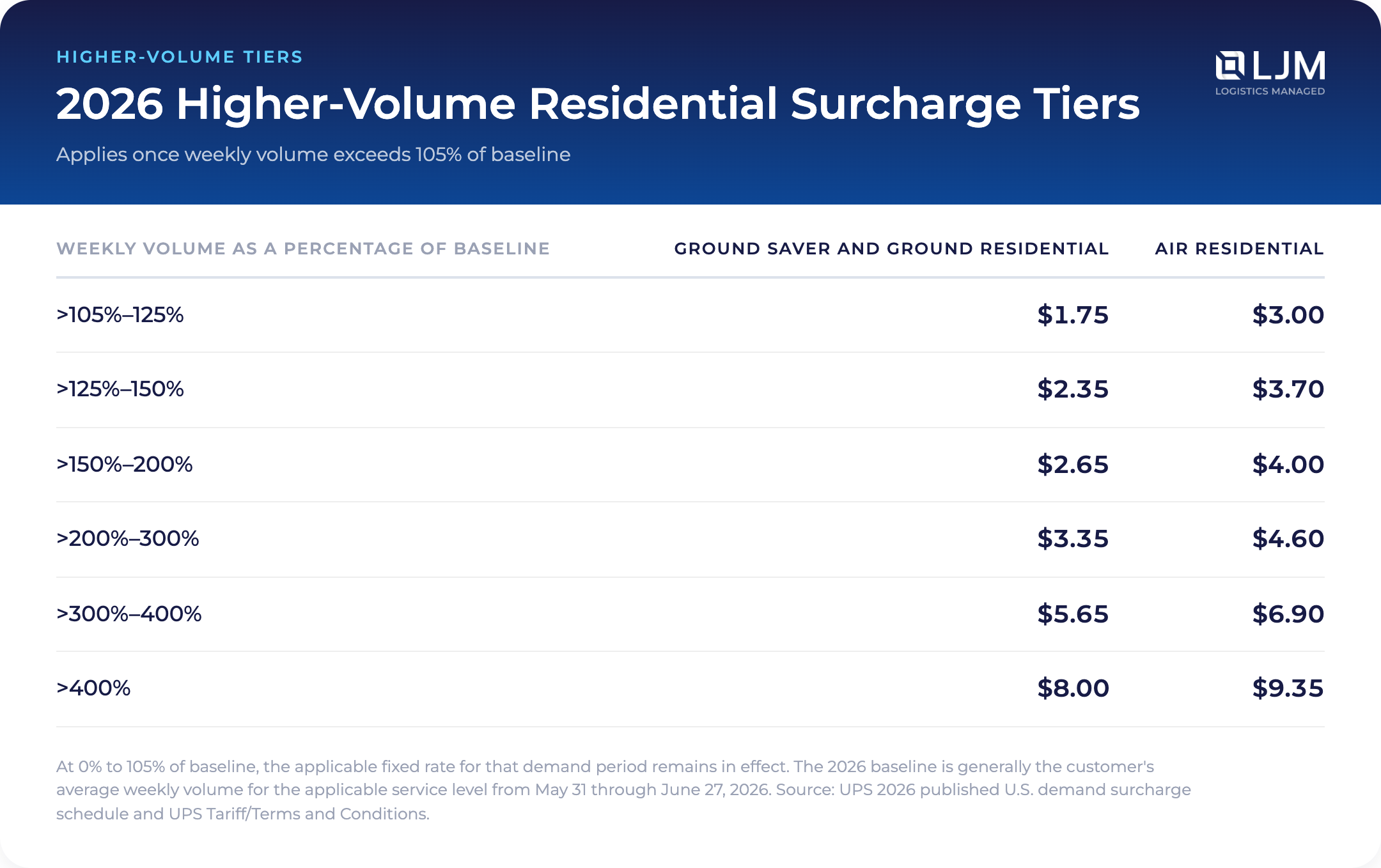
For qualifying higher-volume customers, UPS Next Day Air Commercial and All Other UPS Air Commercial remain at the applicable fixed period rate: $1.35 before and after the core peak, and $2.50 during the core peak, regardless of the peaking factor.
How UPS's 2026 Peak Demand Surcharges Compare With 2025
UPS increased every major comparable rate in its published U.S. demand surcharge schedule from 2025. The largest percentage increases in the fixed schedule apply to residential Ground, Ground Saver and Air packages.
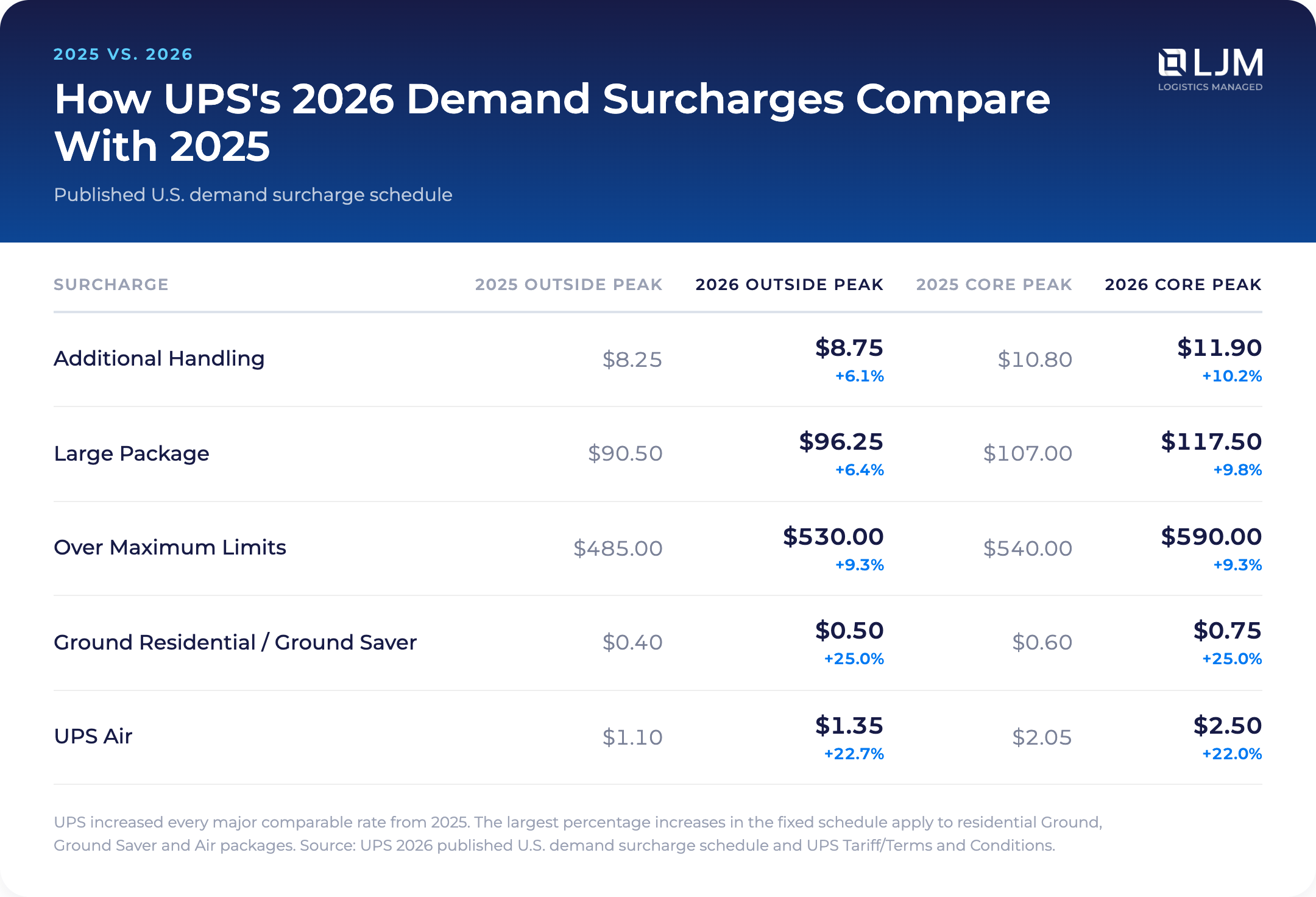
The higher-volume tiers also increased across the board. Ground Residential and Ground Saver rates above 105% of baseline rose approximately 6.6% to 9.4%, while Air Residential tiers increased approximately 6.9% to 9.1%.
The dollar risk remains concentrated in two places. First, non-standard packages can generate triple-digit demand charges on top of already substantial accessorials. Second, enterprise residential shippers can move into a higher tier based on actual weekly performance, even when the annual forecast appeared manageable.
What UPS Shippers Should Watch Before Peak Season
1. The baseline can matter more than the published tier table
A shipper cannot estimate the higher-volume surcharge from its peak season forecast alone. It must first reproduce UPS's service-level baseline, test whether the August-September alternative applies, and then compare projected weekly volume against that number. A lower substituted baseline can move the same holiday volume into a higher tier.
2. The highest tier applies to every package in the service level
The charge is not limited to incremental volume above 105% of baseline. If UPS Ground Residential volume reaches 175% of baseline, the $2.65 rate applies to every UPS Ground Residential package in that weekly invoice period. Small forecast errors near a tier boundary can therefore have an outsized cost impact.
3. Marketing and shipping forecasts must use the same weekly view
A promotion, product launch or late-season demand shift can materially change the applicable tier. Finance, ecommerce, marketing, fulfillment and parcel teams should work from one weekly forecast by service level, rather than separate monthly or channel-level plans.
4. Package characteristics require a separate cost model
Additional Handling, Large Package and Over Maximum demand charges begin almost a month before the fixed Air and residential charges. Shippers should model dimensions, weight, packaging and other triggers independently from service-level demand charges, then combine the results at the package level.
5. Contract protection must reference demand surcharges specifically
Do not assume a discount on the ordinary Residential, Additional Handling or Large Package charge automatically reduces the corresponding demand surcharge. Review the agreement charge by charge for specific waivers, discounts, caps, exclusions and volume commitments.
What Shippers Should Do Now
Build a weekly peak-season model that incorporates:
- Expected volume by UPS service level and invoice week;
- The June 2026 baseline and the potential August-September substitute baseline;
- Qualifying volume across affiliated and related accounts;
- Packages historically assessed Additional Handling, Large Package or Over Maximum charges;
- The underlying accessorial charges and applicable fuel treatment; and
- The discounts, waivers, caps and exclusions written into the current UPS agreement.
Then compare the model with actual 2025 peak invoices. This separates the impact of published rate increases from volume growth, a changed service mix, package characteristics and contract gaps.
Request LJM's Complete 2025-2026 UPS Peak Demand Surcharge Comparison
LJM has completed a detailed comparison of UPS's 2025 and 2026 demand surcharges, including the fixed service-level rates, higher-volume tiers and non-standard-package charges.
Contact LJM to request the full comparison and a custom analysis of your UPS agreement. We will apply the rates to your package profile, weekly volume and contract terms to identify potential discount, waiver and cost-reduction opportunities before peak charges begin.
Access This Content
Change the Economics of Your Shipping
Better Rates.
Complete Visibility.
Strategic Edge.


