USPS 2026 Peak Season Surcharges: Complete Rates, 2025 Comparison and What Shippers Should Watch
The U.S. Postal Service (USPS) has filed its 2026 peak season pricing with the Postal Regulatory Commission, with temporary rates scheduled to take effect at 12 a.m. CT on October 4, 2026 and running through 12 a.m. CT on January 17, 2027, pending favorable PRC review.
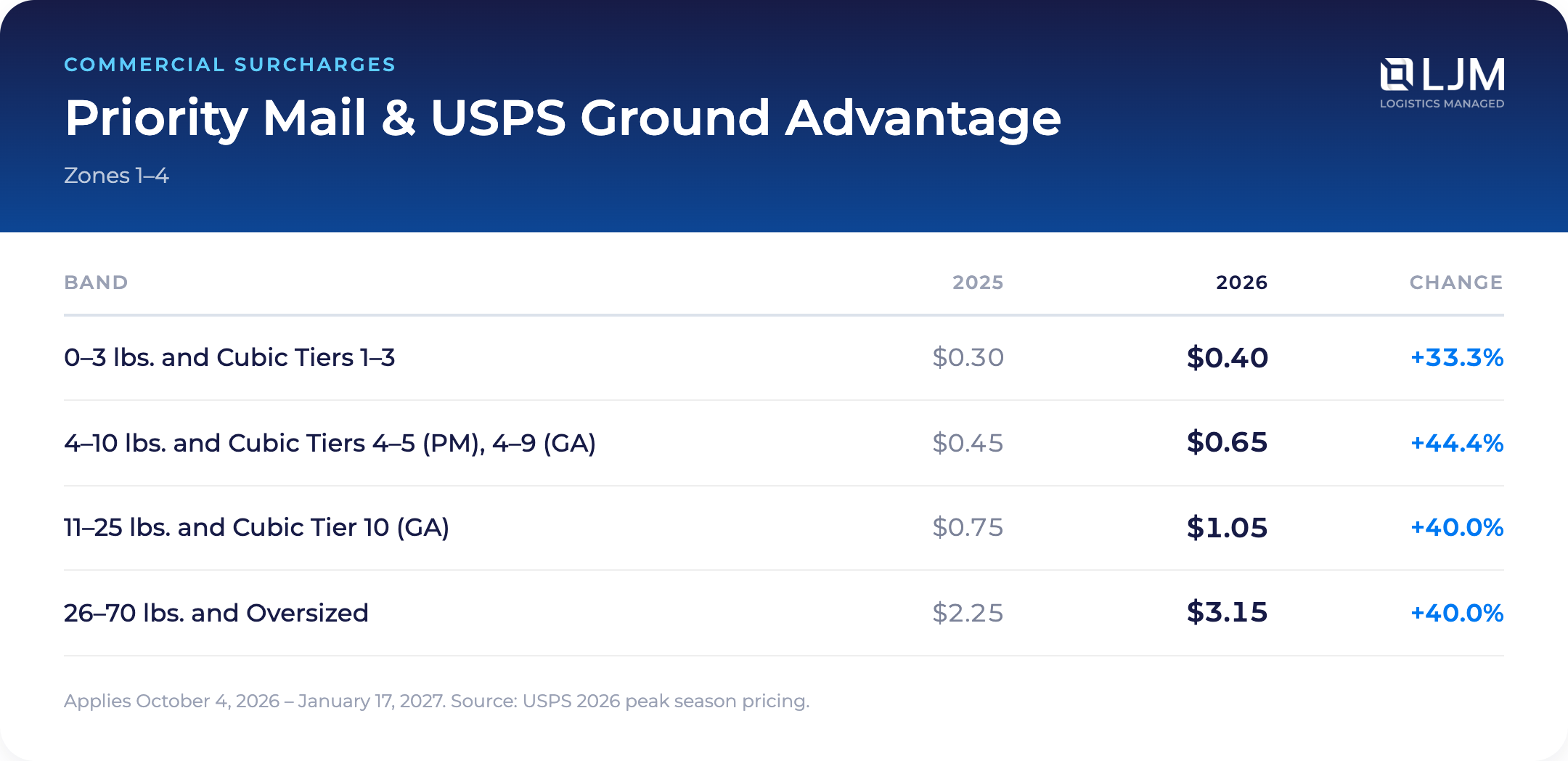
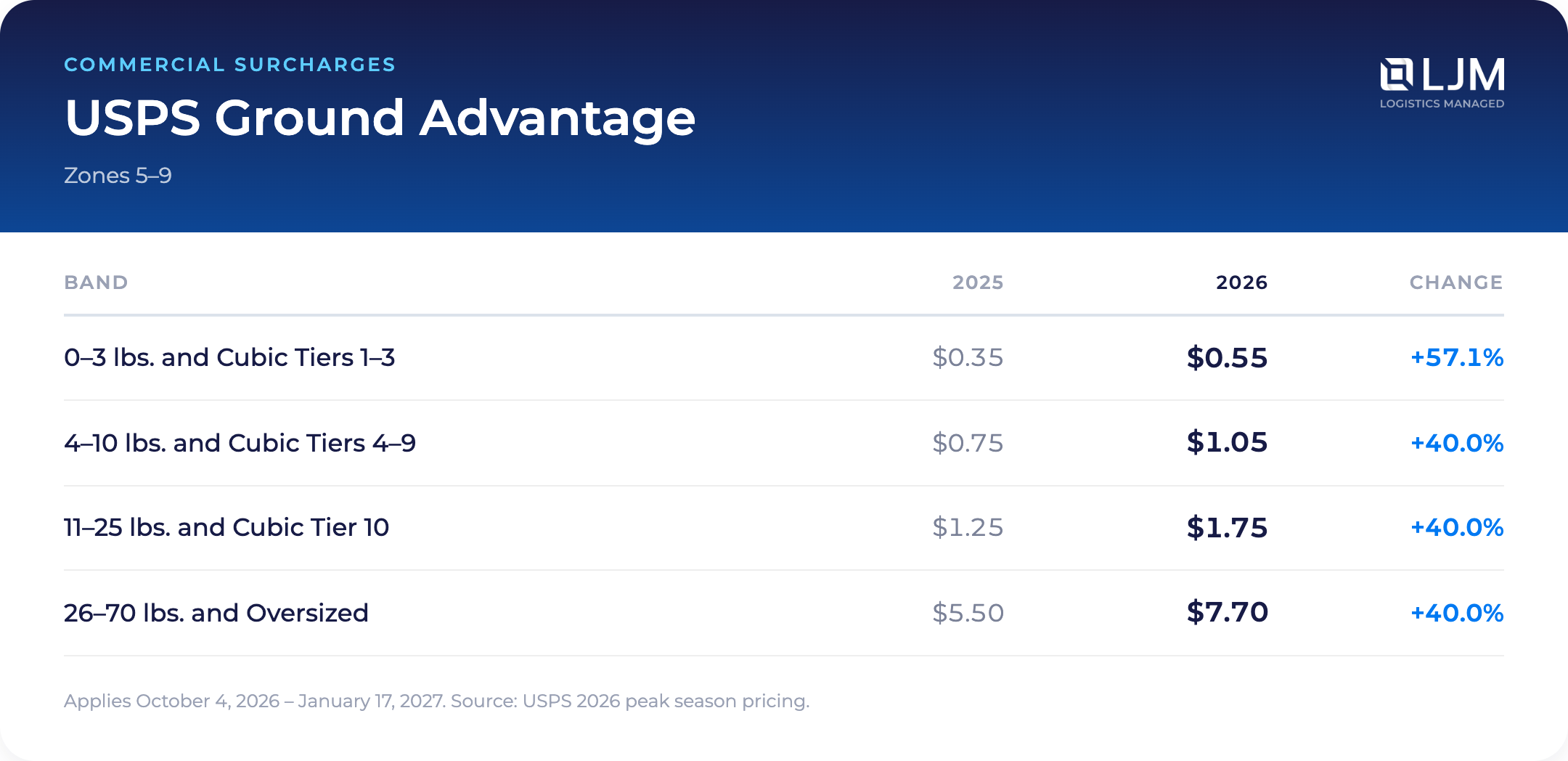
Every comparable USPS peak surcharge increased over 2025, but the increases are not evenly distributed. Commercial surcharges rose by roughly 40% across most services, weight bands and zones, while retail increases were generally smaller. The single largest percentage increase in the filing applies to commercial USPS Ground Advantage in Zones 5-9 at 0-3 lbs and Cubic Tiers 1-3, one of the most common profiles in domestic ecommerce.
USPS also restructured the filing. Parcel Select, which was bundled with commercial Priority Mail and Ground Advantage Zones 1-4 in 2025, now carries its own materially lower schedule.
For shippers, the announced surcharge is only part of the exposure. These seasonal add-ons apply on top of base rates that increased in January, an additional temporary 8% increase implemented in April, and a dimensional weight methodology that tightened in July. The actual impact depends on package characteristics, service mix, zone distribution and the terms of each shipper's agreement.
Key Takeaways
- Every comparable USPS peak surcharge increased for 2026.
- Most commercial surcharges rose approximately 40% year over year.
- Commercial Ground Advantage, Zones 5-9, 0-3 lbs and Cubic Tiers 1-3 increased 57.1% — the largest jump in the filing.
- Parcel Select was separated into its own schedule with increases of only 4.4 to 33.3%.
- Peak surcharges stack on multiple 2026 price increases and tighter dimensional weight rules, so total exposure exceeds the announced increase.
- Prices remain subject to PRC review.
USPS 2026 Peak Season Dates
USPS uses a single, uniform schedule rather than the tiered date structure used by the private carriers. There is no ramp-up period, no core-peak escalation and no post-peak step-down. One rate applies for the entire window from October 4, 2026-January 17, 2027. The affected products are Priority Mail Express, Priority Mail, USPS Ground Advantage and Parcel Select. No other products or services are affected.
USPS 2026 Peak Season Demand Surcharges
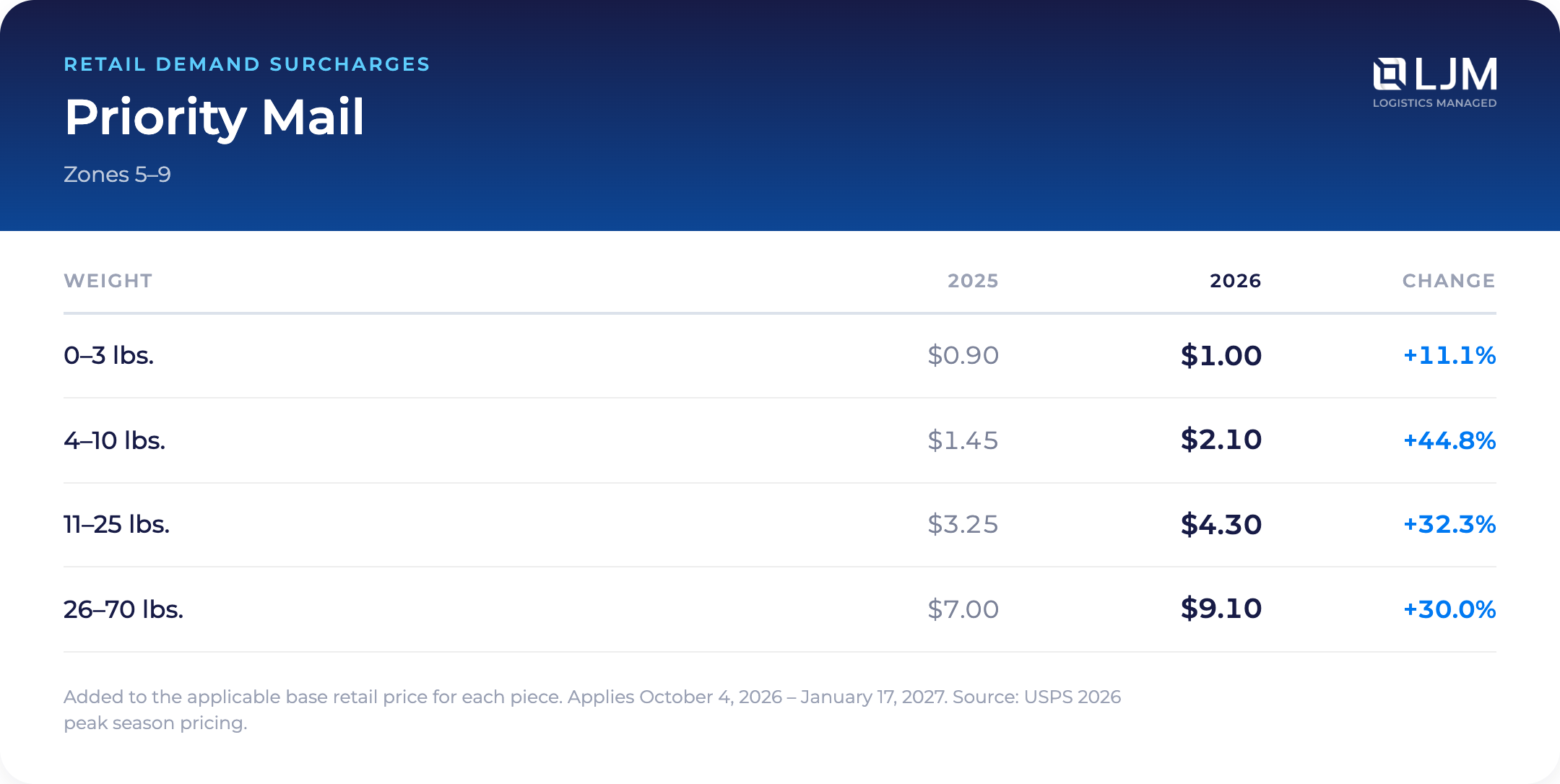
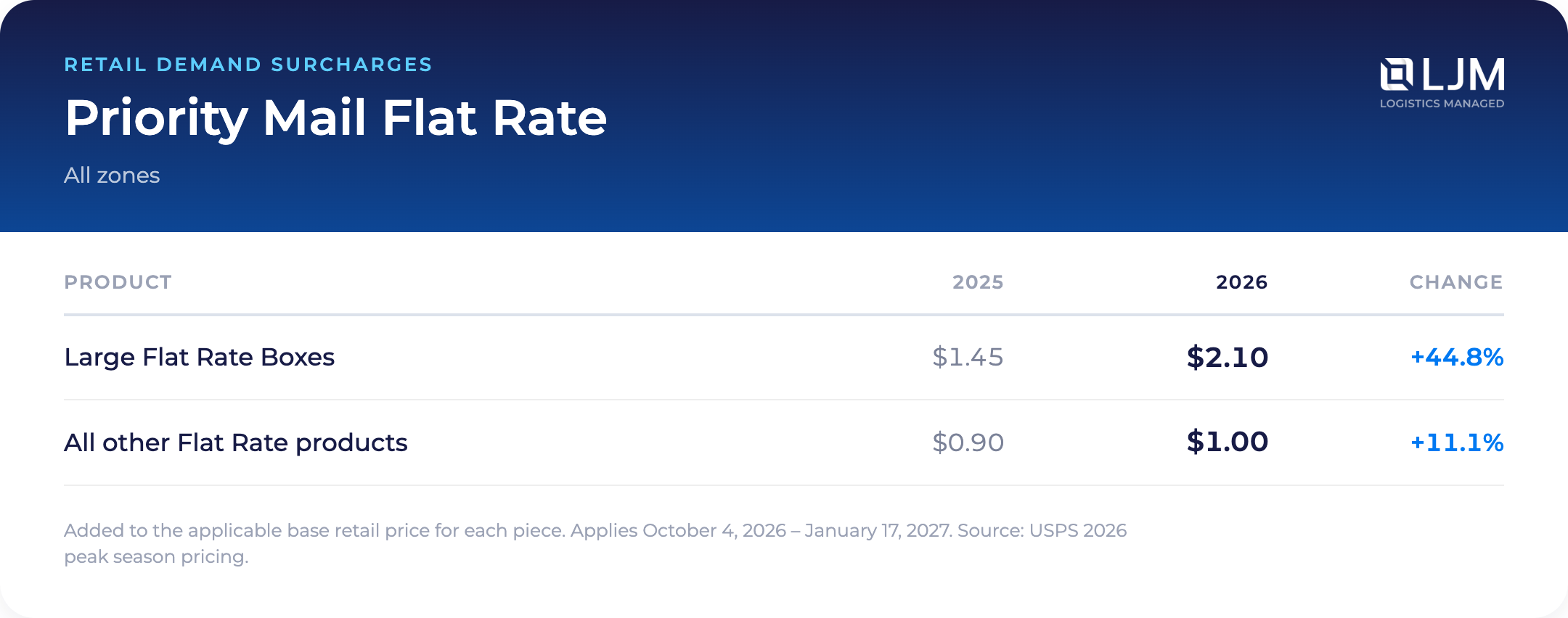
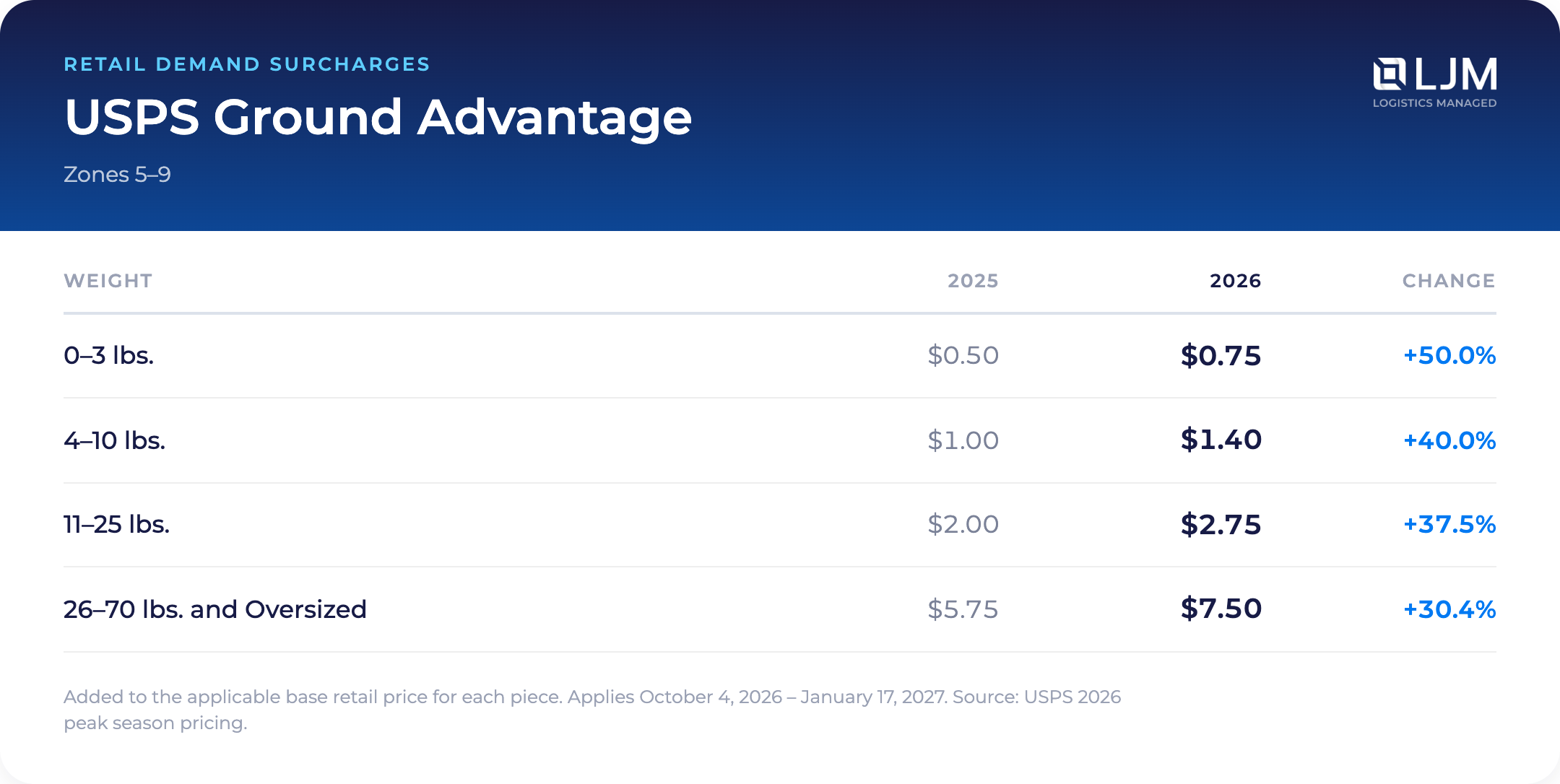
These amounts are added to the applicable base retail price for each piece.
.png)
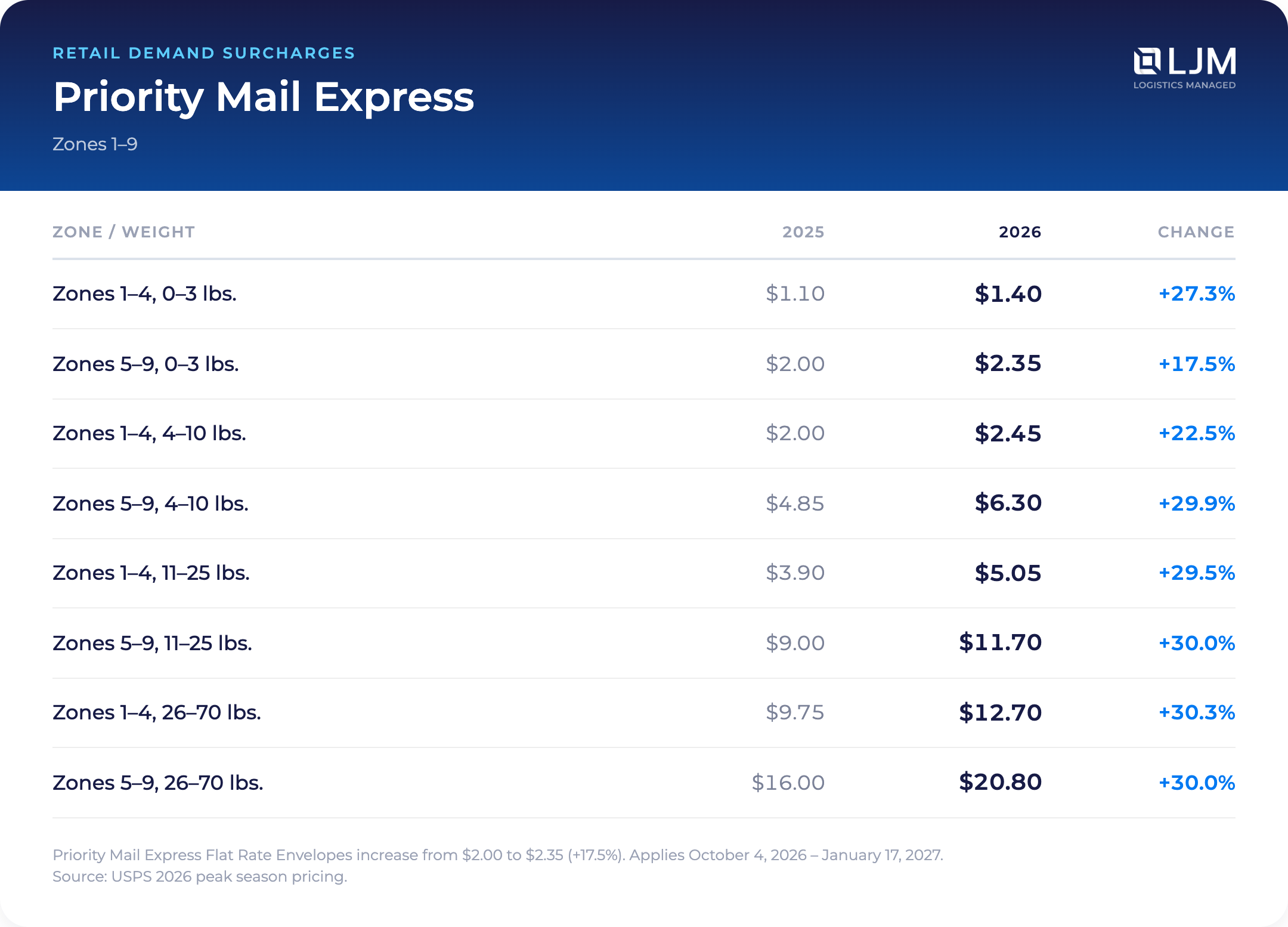
Priority Mail Express Flat Rate: Flat Rate Envelopes increase from $2.00 to $2.35 (+17.5%).
USPS 2026 Peak Season Commercial Surcharges
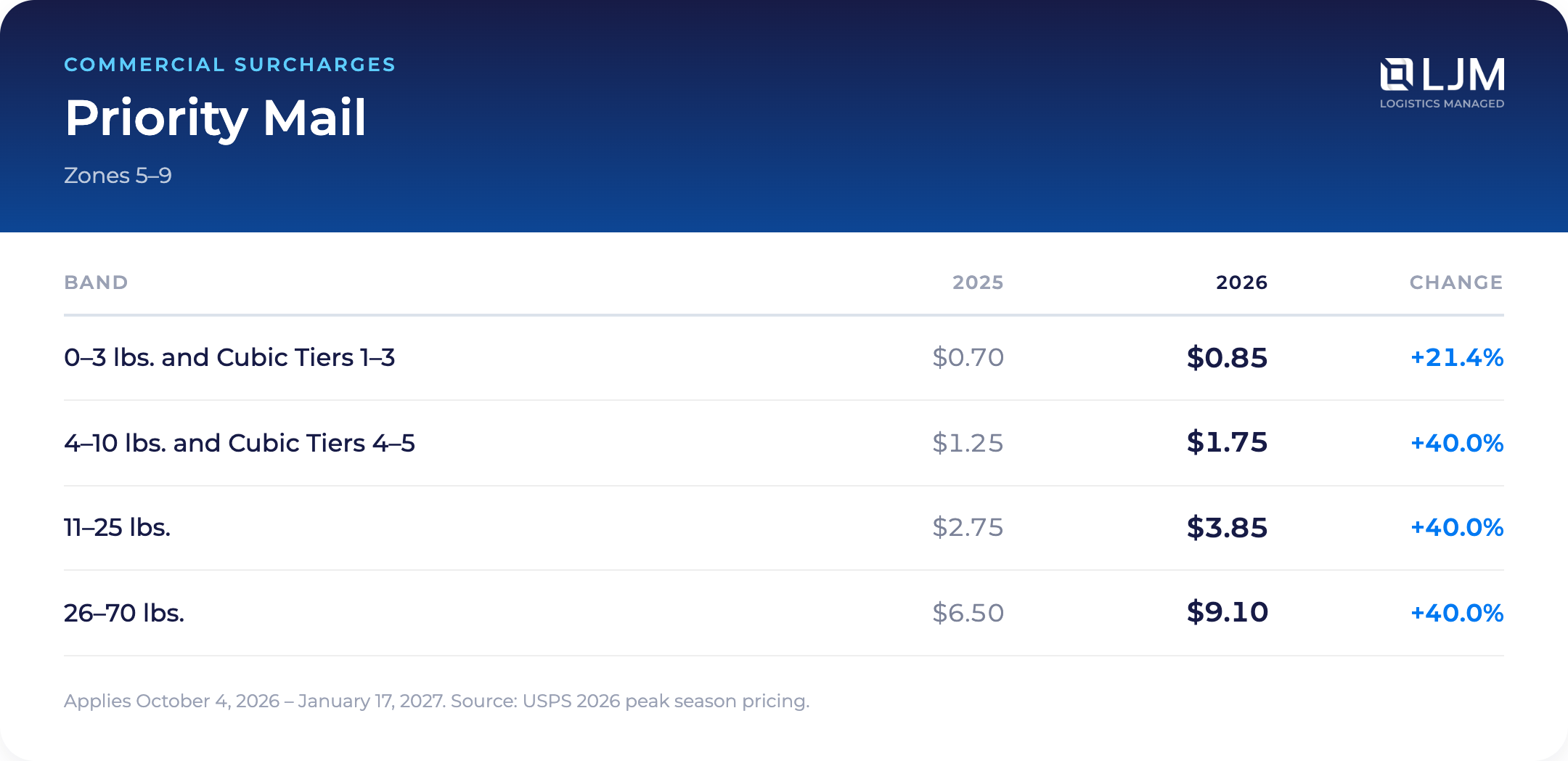
This is where the increases concentrate.
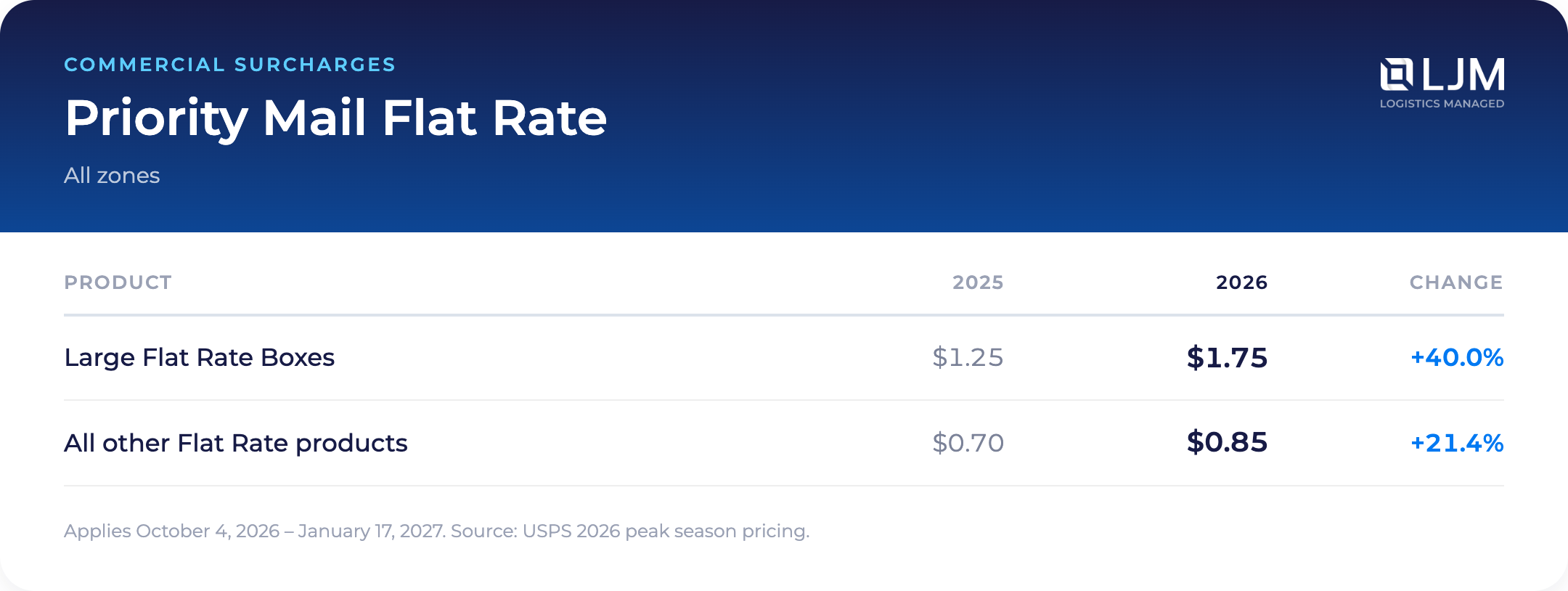
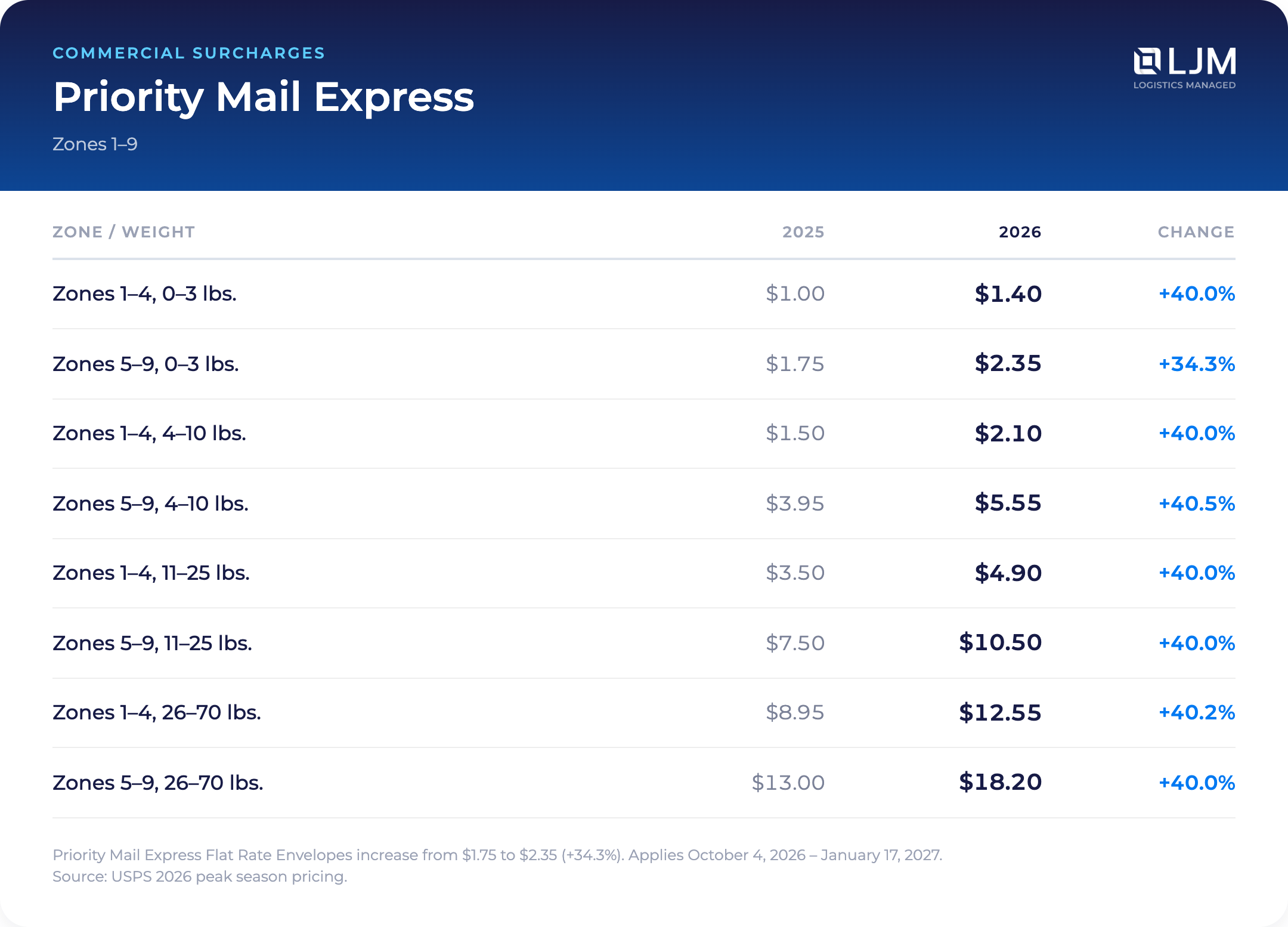
Priority Mail Express Flat Rate: Flat Rate Envelopes increase from $1.75 to $2.35 (+34.3%).
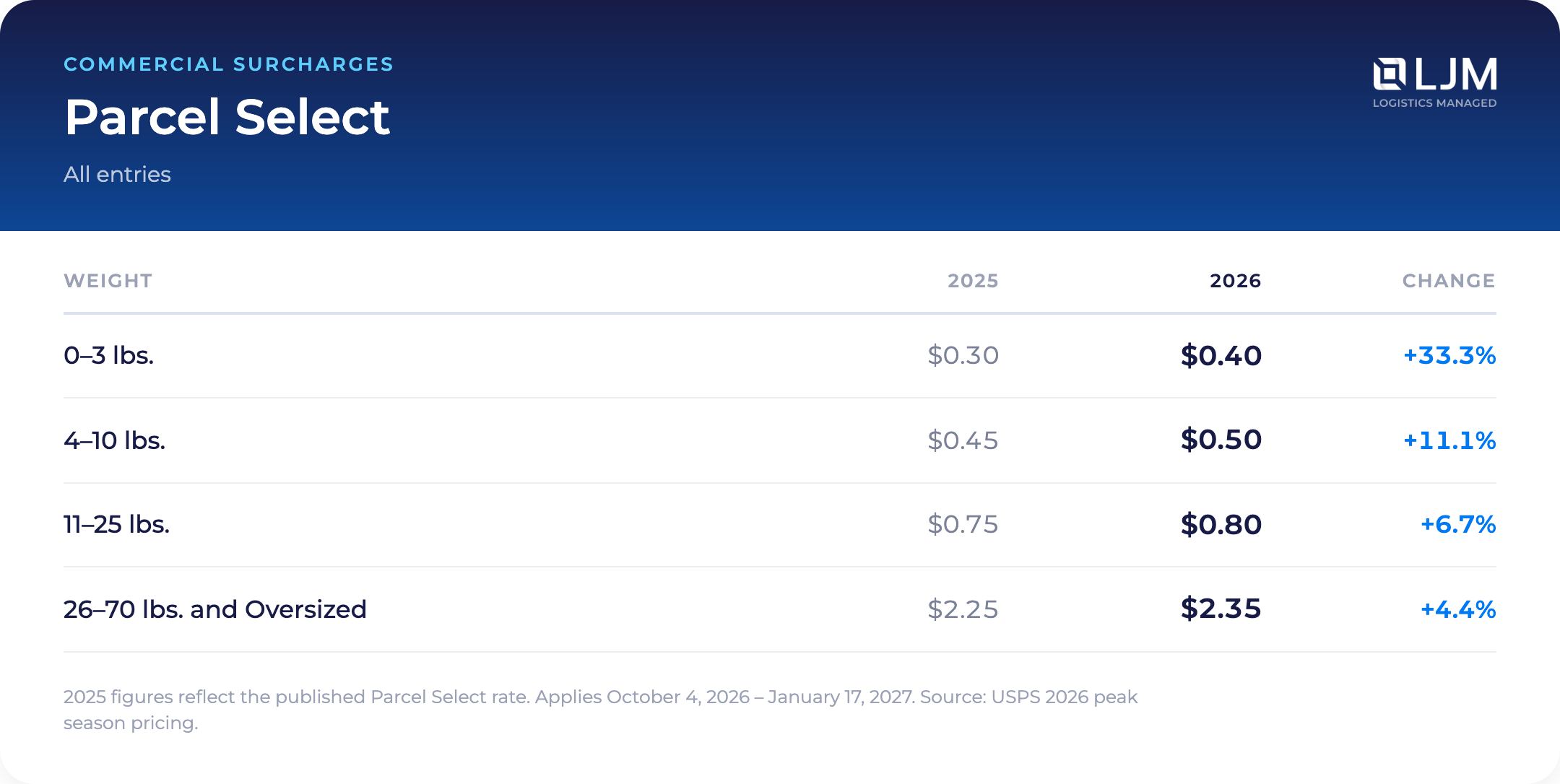
*In 2025, Parcel Select was priced within the commercial Priority Mail and Ground Advantage Zones 1-4 group. The 2025 column reflects the rates that applied to it under that structure.
How USPS's 2026 Peak Surcharges Compare With 2025
Three structural shifts matter more than the individual dollar amounts.
1. Commercial increases significantly outpaced retail
Almost every commercial line item rose 40% or close to it. Retail increases clustered between 25 and 33 percent, with several bands rising far less: retail Priority Mail Zones 5-9 at 0-3 lbs rose 11.1%, and Priority Mail Express Flat Rate Envelopes rose 17.5%.
The practical result is compression. In several bands, the gap between retail and commercial peak pricing narrowed considerably. In one case it disappeared entirely: for Priority Mail in Zones 5-9 at 26-70 lbs, retail and commercial shippers now face the same $9.10 surcharge, where last year commercial paid $0.50 less.
Commercial customers still hold the advantage on base rates. But peak season has become a smaller source of relative advantage than it was in 2025.
2. The lightest parcels absorbed the largest percentage increases YoY
The two biggest percentage jumps in the filing both land on 0-3 lb packages moving to Zones 5-9:
- Commercial Ground Advantage, 0-3 lbs and Cubic Tiers 1-3: +57.1%
- Retail Ground Advantage, 0-3 lbs: +50.0%
In absolute terms these are small — $0.20 and $0.25 per piece. But for a high-volume ecommerce shipper whose profile is concentrated in sub-3-lb parcels, per-piece amounts multiply quickly across a 105-day window. A shipper moving 250,000 commercial Ground Advantage parcels in that weight and zone range absorbs an additional $50,000 relative to a 2025 surcharge run rate, before any base rate movement.
Percentage increases and dollar increases point in different directions in this filing. Both need to be modeled.
3. Parcel Select was separated and largely spared
In 2025, Parcel Select was priced alongside commercial Priority Mail and Ground Advantage Zones 1-4. In 2026 it has its own entry with increases ranging from 4.4 to 33.3% — well below the roughly 40 percent applied elsewhere.
At the heavy end the divergence is significant. Commercial Ground Advantage Zones 5-9 at 26-70 lbs now carries a $7.70 peak surcharge. Parcel Select at the same weight carries $2.35.
For shippers with the volume and network position to inject deeper into the USPS system, the relative economics of Parcel Select improved this peak season.
4. Cubic pricing carries the surcharge
Cubic tiers are explicitly named throughout the commercial schedule and are not exempt. Cubic Tiers 1-3 track the 0-3 lb band, Tiers 4-5 (Priority Mail) and 4-9 (Ground Advantage) track the 4-10 lb band, and Ground Advantage Cubic Tier 10 tracks the 11-25 lb band.
Shippers who moved volume into cubic pricing for the dense, small-format parcels it rewards will see peak surcharges applied at the equivalent weight-band rate.
Higher Surcharges Are Stacking on a Higher Base
As with the private carriers, comparing this year's peak surcharge to last year's understates actual exposure. Three changes earlier in 2026 raised the underlying cost of shipping before peak pricing is applied.
Base competitive rates increased in January: The January 2026 shipping services price change raised Priority Mail an average of 6.6 percent, Priority Mail Express an average of 5.1 percent, and USPS Ground Advantage an average of 7.8 percent, with variation across weight breaks and zones.
USPS implemented an additional temporary increase in April: Effective April 26, 2026, USPS applied an average 8 percent time-limited increase to Priority Mail Express, Priority Mail, USPS Ground Advantage and Parcel Select. That increase remains in effect through January 17, 2027, overlapping the entire peak season pricing window.
The dimensional weight divisor tightened in July: Effective July 12, 2026, USPS aligned its dimensional weight divisor with industry standards, moving it from 166 to 139 for Priority Mail Express, Priority Mail, USPS Ground Advantage and Parcel Select. USPS also began rounding package dimensions up to the next whole inch for dimensional weight calculations.
That third change deserves particular attention going into peak. A smaller divisor produces a larger dimensional weight for the same box, and rounding dimensions up can increase it further. For lightweight, bulky packages, those changes can move a parcel into a higher billable weight band, and USPS peak surcharges are assessed by weight band.
A commercial Ground Advantage parcel in Zones 5-9 that bills at 10 lbs carries a $1.05 peak surcharge. The same parcel billing at 11 lbs carries $1.75. A package characteristic change made in July can therefore increase peak surcharge on that shipment by approximately 67 percent, independent of the year-over-year increase in the surcharge itself.
The same dynamic applies at every band boundary in the schedule, and the dollar consequences grow at the heavy end.
What USPS Shippers Should Do Before Peak Season
1. Re-run your package profile against the new dimensional weight rules
Any forecast built on pre-July billable weights is stale. Re-rate a representative sample of your actual shipping profile using the 139 divisor and identify which packages crossed into a new weight band.
Those packages are where surcharge exposure compounds. The DIM change can increase billable weight and move the shipment into a higher peak-surcharge band.
2. Model commercial and retail separately if you use both channels
The gap narrowed this year, and in at least one band it closed. If your organization ships through both retail counter transactions and commercial rates, the relative cost comparison you built last peak may no longer hold.
3. Evaluate whether Parcel Select is now a better fit for part of your volume
Parcel Select's peak treatment diverged sharply from the rest of the filing this year. Whether that translates into savings depends on your induction points, volume, transit expectations and whether you can consolidate through a qualified partner.
The question is not whether Parcel Select is cheaper in the abstract. It is whether the specific segment of your volume that could realistically move like heavy, zone-skipped, less time-sensitive is large enough to matter.
4. Confirm how peak pricing applies under your agreement
Published peak surcharges are the default, not necessarily the outcome. Shippers operating under negotiated agreements should confirm in writing:
- Whether and how temporary peak pricing is applied to negotiated rates;
- Whether existing discounts extend to the peak add-on;
- How cubic tier pricing is treated during the peak window;
- Whether any volume or committed-spend thresholds are affected by peak-period volume; and
- How the July dimensional weight change interacts with your rate structure.
Do not assume a discount on base postage flows through to the seasonal amount.
5. Watch for revisions before October 4
These rates are pending PRC review under Docket No. CP2026-10. This is not a formality. In 2025, USPS revised its announced peak pricing after the initial release, reducing the commercial Priority Mail, Ground Advantage Zones 1-4 and Parcel Select 26-70 lb surcharge from $3.00 to $2.25 and adding cubic tier and oversized detail that had been omitted.
Build your forecast on the filed rates, but plan to re-validate before implementation.
What Shippers Should Do Now
Start with a package-level forecast that incorporates:
- Expected weekly volume across the full Oct. 4 – Jan. 17 window, including the January returns period;
- Service mix across Priority Mail Express, Priority Mail, Ground Advantage and Parcel Select;
- Weight band distribution, re-calculated under the 139 dimensional weight divisor;
- Zone distribution, with particular attention to the Zones 1-4 versus 5-9 split;
- Cubic tier volume and how it maps to the equivalent weight bands; and
- The discounts, exclusions and peak-pricing language in your current agreement.
Then compare that forecast against your actual 2025 peak invoices. That comparison will show whether your greatest exposure comes from the surcharge increase itself, from volume growth, from service selection, from package characteristics, or from gaps in your contract.
In our experience, it is rarely the surcharge alone.
Request LJM's Complete 2025–2026 USPS Peak Surcharge Comparison
Contact LJM to request the full comparison and a custom analysis of your USPS profile. We will apply the rates to your specific package mix and agreement terms to identify cost-reduction opportunities before peak season begins.
Access This Content
Change the Economics of Your Shipping
Better Rates.
Complete Visibility.
Strategic Edge.


