Guide to UPS’s 2027 General Rate Increase: How Shippers Can Beat the Sticker Price and Keep Costs Down
The 5.9% Headline Is Only the Starting Point
UPS will increase published Daily Rates for Ground, Air and International services by an average net 5.9% on December 21, 2026. That number is useful for understanding the carrier’s broad pricing direction. It is not a reliable budget assumption for an individual shipping program. The real effect on any shipper depends on its package profile, service and zone mix, contract terms, surcharge frequency and operational decisions.
Residential, Delivery Area, Additional Handling, Large Package, fuel, Address Correction and other charges can materially change the effective increase. Many of those common accessorial charges are rising closer to 9%, and some commercial Large Package charges are increasing by more than 15%.
This guide will help you identify the changes most likely to affect your budget, calculate the true net impact and prioritize actions that can reduce your exposure before the new rates reach your invoices.
What UPS Is Changing for 2027
Published Package Rates
The published Daily Rates for UPS Ground, UPS Air and international services will increase an average net 5.9%.
Individual rate cells do not all move by exactly the same percentage. For example, the published price of a one-pound UPS Ground package to Zone 2 rises from $11.99 to $12.70, or 5.9%, while the same package to Zone 8 rises from $15.03 to $15.95, or 6.1%.
The mix of services, weights and zones in your actual shipping history determines the weighted base-rate impact.
Accessorials Rise Faster Than the Headline Rate
Many frequently assessed domestic accessorial charges are increasing approximately 8.5% to 9.6%, significantly outpacing the 5.9% headline rate. Some Commercial Large Package Surcharges are rising even faster, from approximately 11.7% to 15.4%, depending on zone. Declared Value for Carriage under Package Shield increases 17.1% per $100 of value.
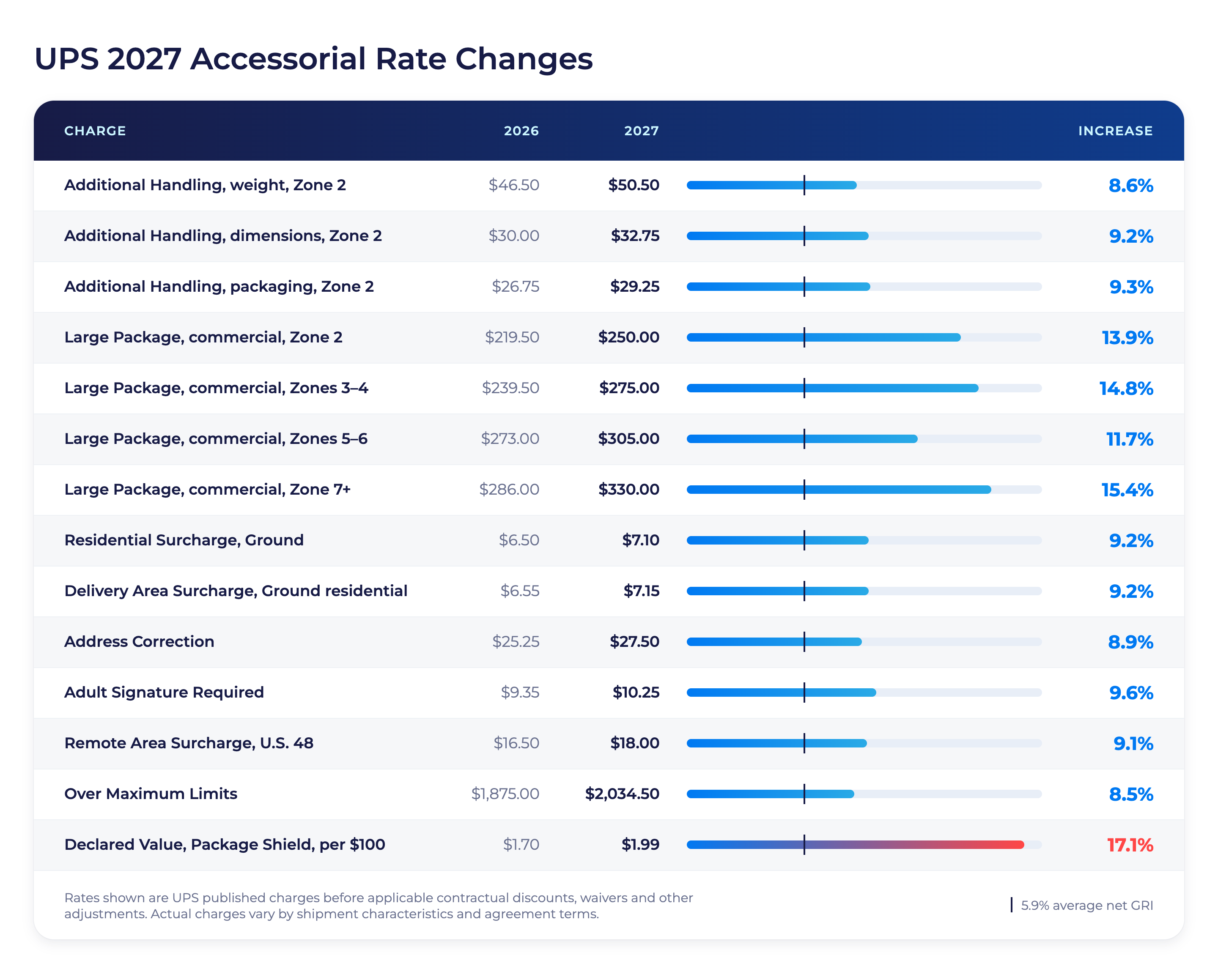
What this means for shippers: Competitive transportation discounts may not prevent a materially higher net increase if your accessorial charges are lightly discounted, uncapped or excluded from contractual protections.
Additional Handling Minimum Billable Weight Increases
Effective December 21, 2026, UPS will increase the Additional Handling minimum billable weight from 40 to 50 pounds, a 25% increase. Under UPS's existing rules, this minimum applies to packages assessed Additional Handling for dimensional characteristics, including length, width, length plus girth or cubic size.
A package with a billable weight below 50 pounds that triggers dimension-based Additional Handling may therefore be rated at the new 50-pound minimum, increasing transportation charges in addition to the applicable Additional Handling fee.
What this means for shippers: The financial impact depends on the service, zone, package characteristics and contract terms.
ZIP Codes and Zones Will Change
UPS will revise the ZIP codes aligned to certain zones and the ZIP codes to which Area Surcharges apply.
What this means for shippers: Even if your package mix and negotiated discounts remain unchanged, these geographic revisions can alter the rate cell or surcharge applied to individual shipments.
A New Origin-Based Surge Fee Framework Is Coming
UPS has announced an additional per-package Surge Fee for qualifying domestic Ground and Ground Saver shipments originating from designated ZIP codes, effective on or after December 21, 2026. The applicable ZIP codes, charges and customer qualification criteria should be reviewed against UPS's latest published schedule before budgets are finalized.
What this means for shippers: Shippers should account for this potential exposure in preliminary budgets and update their forecasts when the applicable fees and eligibility criteria are confirmed.
A New Rescheduling Charge Appears
UPS My Choice for Business Reschedule Delivery moves from no listed charge to $9.99.
What this means for shippers: The financial impact will depend on how frequently the service is used, who bears the charge and whether applicable account terms provide any protection.
Related UPS Pricing Changes to Keep Separate From the GRI
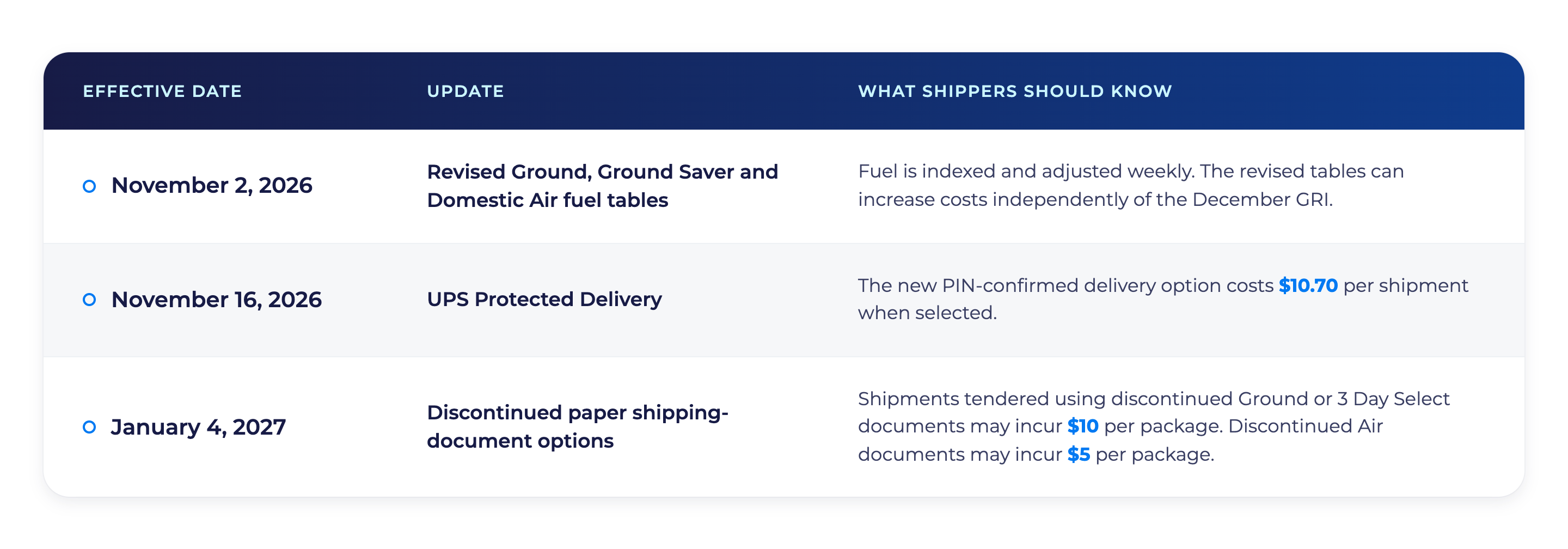
UPS also announced several changes near the 2027 GRI. They affect shipping costs, but they should not be presented as components of the 5.9% increase.
Why Your Effective UPS Shipping Cost Increase Will Not Equal 5.9%
A credible 2027 forecast has to be built from shipment-level data. Applying 5.9% to last year’s total UPS spend ignores the variables that determine what actually reaches an invoice.
- Service and zone mix: Ground, Air and international rate cells move differently. Zone revisions can also change which cell applies.
- Package characteristics: Weight, dimensions, packaging and length-plus-girth determine whether Additional Handling, Large Package or Over Maximum charges apply.
- Contract structure: Transportation discounts, minimum charges, earned discounts, accessorial concessions, caps and exclusions determine how much of the published change reaches your net cost.
- Surcharge incidence: A 9% fee increase has little effect if the fee rarely occurs. It can dominate the budget when it appears across a large share of shipments.
- Fuel and fee interaction: Fuel is calculated separately and can apply beyond base transportation charges under UPS rules and your agreement, compounding the impact.
- Origin and destination geography: Zone mapping, Delivery Area and Remote Area lists, and the coming origin-based Surge Fee can all change the result.
- Operational change: New products, packaging, fulfillment locations, promotions and customer delivery promises can make historical averages misleading.
Three Examples of Hidden Budget Exposure
Residential volume: For illustration, 100,000 Ground packages assessed the Residential Surcharge would generate $60,000 in additional annual fees from the $0.60 increase alone, before fuel and transportation-rate changes.
Large commercial packages: One thousand commercial Large Packages to Zones 3–4 would produce $35,500 in added surcharge expense from the move from $239.50 to $275.00, before fuel and base-rate changes.
Additional Handling weight floor: A package rated below 50 pounds that triggers dimensional Additional Handling may become subject to the new 50-pound minimum, increasing transportation charges in addition to the applicable surcharge. The shipper can therefore pay more in both transportation and the accessorial fee.
How to Calculate the Impact on Your Shipping Program
An effective 2027 UPS cost analysis should identify where increases will have the greatest impact, how much protection your current agreement provides and which actions can reduce your exposure.
1. Re-Rate Actual Shipments
Apply the 2027 base rates, accessorial amounts and rules to at least 12 months of shipment-level history.
Preserve the service, zone, billed weight, dimensions, residential status and surcharge flags for each shipment.
2. Calculate Gross and Net Impact Separately
First measure the published increase. Then apply your current agreement’s discounts, minimums, caps and waivers to determine the expected net increase.
3. Rank Cost Drivers by Dollars, Not Percentage
A 15% increase on a rarely assessed charge may matter less than a 9% increase applied to most packages.
Multiply each rate change by its expected frequency to identify where the greatest financial exposure sits.
4. Audit Package-Characteristic Exposure
Identify packages close to Additional Handling and Large Package thresholds. Model both the new 50-pound minimum and the higher accessorial rates.
5. Map Geographic Changes
Reconcile origin and destination ZIP codes against the revised zone and Area Surcharge lists.
Add the origin-based Surge Fee when UPS publishes the final ZIP codes and prices.
6. Model Operating Scenarios
Test packaging, service, carrier, fulfillment and delivery-promise changes before implementing them.
Include the potential effect on transit time, customer experience and operational complexity.
7. Set a Measurement Baseline
Establish your expected 2027 cost per package, surcharge rate and service performance so the organization can detect cost drift after implementation.
What Shippers Can Do About the UPS Cost Increase
The right response is rarely a single discount request.
UPS pricing affects procurement, packaging, fulfillment, inventory, finance and customer experience. The strongest cost plans combine commercial and operational actions.
- Negotiate the Charges Your Data Shows Matter Most
A larger headline transportation discount may not solve the problem if Residential, Delivery Area, Additional Handling or Large Package charges drive your increase.
Prioritize accessorial discounts, waivers, caps, minimum-charge relief and fuel treatment based on measured exposure.
- Redesign Packages Near Carrier Thresholds
A small reduction in dimensions or a different packaging configuration can prevent a recurring Additional Handling or Large Package charge.
Start with high-volume SKUs and packages close to the qualifying limits.
- Use Service Levels Deliberately
Compare the promised transit time with the service actually required.
Reserve premium Air services for orders that need them and model Ground alternatives where the delivery commitment remains acceptable.
- Route by Package Economics
Lightweight residential, remote-area and oversized packages do not all belong with the same carrier.
Build routing rules that account for service, zone, package characteristics, carrier thresholds and the customer promise.
- Revisit Inventory and Origin Strategy
Positioning inventory closer to demand can reduce zones and create more economical Ground options.
It may also change exposure to UPS’s new origin-based Surge Fee, making origin ZIP analysis essential.
- Improve Address and Shipment Data
With Address Correction rising to $27.50 and Missing PLD increasing to $5.10, data quality becomes a direct cost-control lever.
Validate addresses before label creation and monitor recurring correction patterns by channel or facility.
- Monitor Invoices Against the Modeled Result
A 2027 plan is incomplete without ongoing verification.
Track realized cost per package, accessorial incidence, fuel, minimum-charge impact and carrier compliance with negotiated terms.
What to Ask UPS Before the 2027 GRI Takes Effect
If you are navigating UPS’s GRI on your own, here are a few questions LJM’s ex-carrier pricing experts recommend you ask your account representative:
- Which rate cells and accessorials in our agreement are protected, capped or excluded from the 2027 increases?
- How will the 50-pound Additional Handling minimum interact with our current transportation discounts and minimum charges?
- Which of our origin and destination ZIP codes are changing zones or Area Surcharge status?
- Will our account qualify for the new origin-based Surge Fee, and how will UPS define qualification?
- Which accessorials will be included in the fuel-surcharge calculation under our agreement?
- What concessions are available in exchange for committed volume, service changes or a longer agreement term?
Build a 2027 Plan Around Your Actual Shipping
No published guide can determine the exact effect of UPS’s 2027 changes on a specific company.
That requires the company’s shipment history, current contract, package profile, geography and operating plans.
LJM can model the 2027 rates and rules against your actual data, identify the fees and shipments creating the greatest exposure, evaluate contract protections, and quantify the financial effect of negotiation and operational alternatives before you act.
Request a 2027 UPS Rate Impact Consultation:
https://www.myljm.com/schedule-demo
Sources
UPS 2027 Rates and Previews
https://www.ups.com/us/en/support/shipping-support/shipping-costs-rates
UPS 2027 Daily Package Rate Preview
https://delivery-p55671-e392469.adobeaemcloud.com/adobe/assets/urn:aaid:aem:53ad364c-2043-4ca7-a6a4-818a4b915dcf/original/as/preview-ups-daily-package-rates.pdf
UPS 2027 Value-Added Services and Other Charges
https://delivery-p55671-e392469.adobeaemcloud.com/adobe/assets/urn:aaid:aem:1ef72ab1-a7b1-49b9-b295-a1a8d376e78a/original/as/preview-changes-package-value-added-services-other-charges.pdf
UPS 2026 Daily Rate and Service Guide
https://assets.ups.com/adobe/assets/urn:aaid:aem:356d938a-4f0a-4c71-b50e-bdd890f50b47/original/as/daily-rates-us-en.pdf
UPS Fuel Surcharge Changes Effective November 2, 2026
https://delivery-p55671-e392469.adobeaemcloud.com/adobe/assets/urn:aaid:aem:8ea98d87-766b-4135-8267-b9c4d3a6daad/original/as/fuelsurcharge-us-en.pdf
Access This Content
Change the Economics of Your Shipping
Better Rates.
Complete Visibility.
Strategic Edge.


