LJM's 2026 Peak Season Shipping Playbook
LJM | 2026 PEAK SEASON
LJM's 2026 Peak Season
Shipping Playbook
Comprehensive round-up of carrier rates and actions to protect your margins this peak season
Rates and carrier rules current as of September 2, 2026.
CONTENTS
What's Inside
01 2026 Peak Season Surcharge Overview
02 How Do I Prepare for Peak Season
03 FedEx 2026 Peak Season Domestic Demand Surcharges
04 UPS 2026 Peak Season Domestic Demand Surcharges
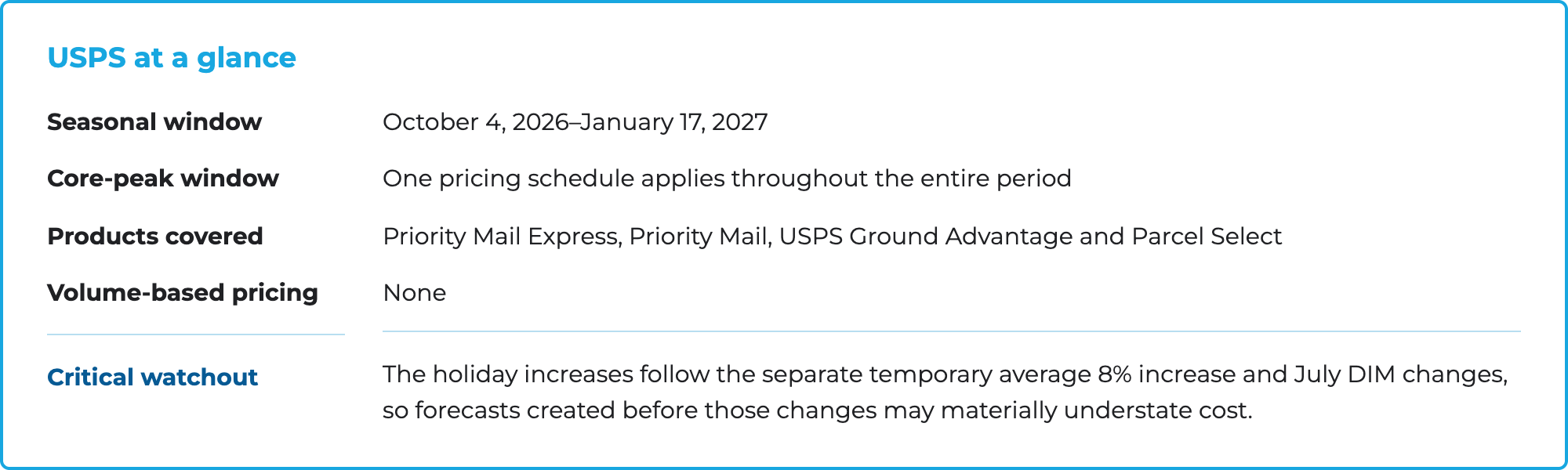
05 USPS 2026 Temporary Peak Pricing
06 International Demand and Surge Fees
07 Operational Best Practices for Peak Season Shipping
08 Get a 2026 Peak Season Cost Impact Analysis
01 / Overview
2026 Peak Season Surcharge Overview
Domestic and international pricing windows overlap, but they do not create the same exposure. Peak season begins before the holiday rush. FedEx’s newly announced international non-standard-package demand charges begin September 21, followed by UPS domestic demand charges and revised international Surge Emergency Fees on September 27, then FedEx domestic charges on September 28. USPS begins one uniform seasonal schedule on October 4. The highest carrier rates apply during the core holiday window, while some charges continue into January. FedEx’s announced international non-standard fees remain in effect through February 7, 2027, and UPS maintains additional international lane-based fees that remain in effect until further notice.
Seven things matter most in 2026 peak season fees:
- Every major comparable UPS and FedEx demand surcharge increased from 2025; every comparable USPS temporary surcharge also increased in its filing.
- Non-standard packages remain the largest per-piece risk. Core-peak demand add-ons reach $595 at FedEx and $590 at UPS for unauthorized or over-maximum packages, before underlying charges.
- Fixed residential and lower-cost services absorbed some of the sharpest percentage increases, including 25% increases for UPS Ground Residential/Ground Saver and FedEx Ground/Home Delivery outside the core peak.
- High-volume UPS and FedEx pricing depends on weekly volume relative to a baseline. The applicable tier can change as actual demand changes.
- Peak fees stack on base transportation, accessorial, fuel and other charges. USPS also enters peak after 2026 base-price, temporary-rate and dimensional-weight changes.
- Contract language determines the net result. A discount on an ordinary accessorial or residential charge may not protect the corresponding demand surcharge.
- International exposure extends the calendar and adds lane-based fees. Shippers need origin, destination, direction, service and billable-weight data in the model.
When Do 2026 Peak Season Demand Surcharges Start
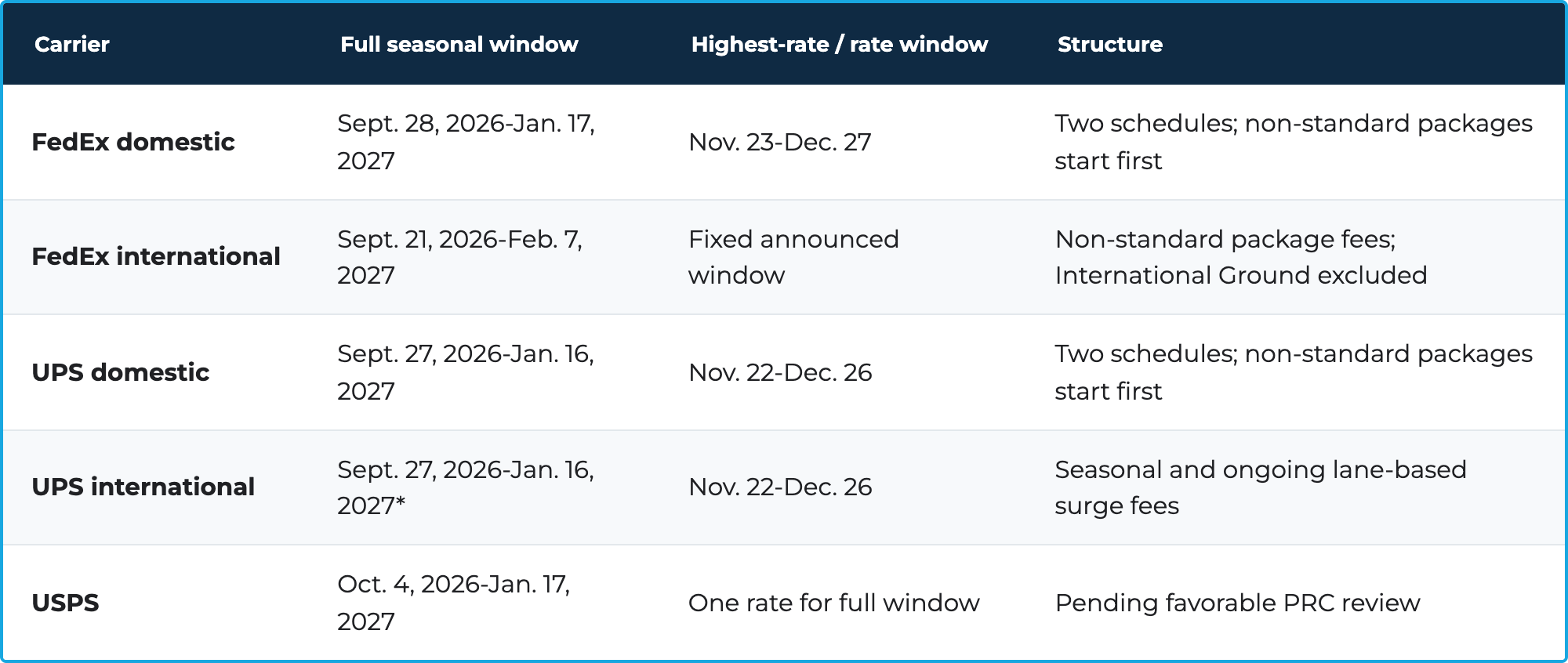
*UPS also lists ongoing international lane fees that remain in effect until further notice. Sources: FedEx Peak 2026 Blog Post.docx; FedEx 9-21-26 International Non-Standard Demand Surcharges; 2026 UPS Peak Surcharges and Surge Fee PDFs; USPS 2026 Peak Season Surcharges blog draft.
02 / Peak Season Planning
How Do I Prepare for Peak Season
7 analyses that will help you project costs, optimize your shipping network, and make better operational decisions this peak season.
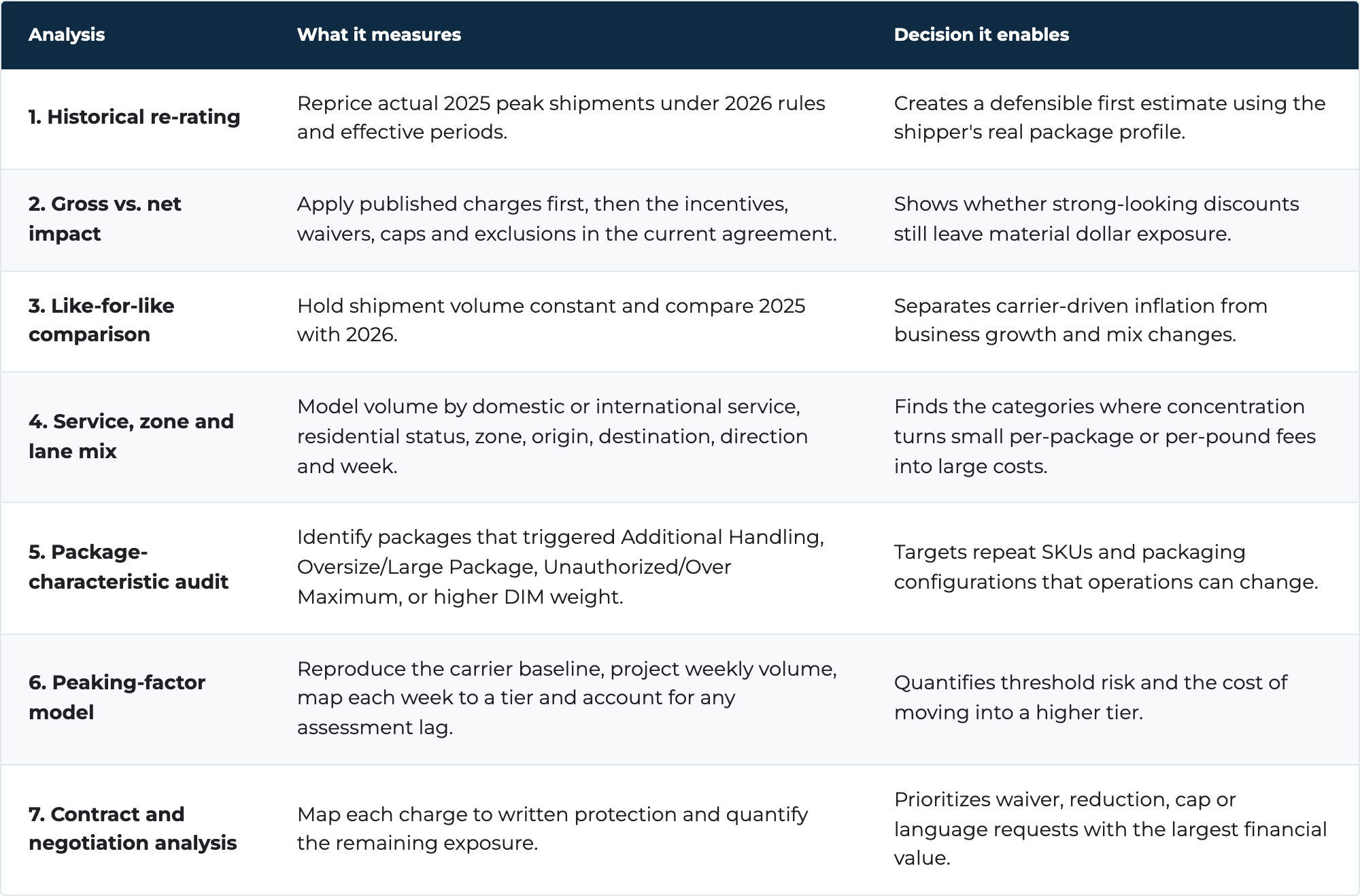

Peak Season Planning Data Checklist
- Package-level shipment history covering the 2025 peak period and the carrier's 2026 baseline period.
- Invoice detail showing domestic or international service, origin, destination, import or export direction, zone, billed weight, dimensions, residential status and accessorial assessments.
- The current carrier agreement, amendments and written demand-surcharge concessions.
- A weekly 2026 forecast aligned across finance, marketing, ecommerce, operations and parcel teams.
- SKU and packaging data for repeat non-standard or dimensionally rated shipments.
03 / FedEx Peak Season Demand Surcharges
FedEx 2026 Peak Season Domestic Demand Surcharges

FedEx Peak Season Additional Handling, Oversize and Unauthorized Surcharges

These seasonal charges apply in addition to the corresponding underlying charge. At published 2026 rates, a package assessed the $1,875 Ground Unauthorized Package Charge during the core peak can also incur the $595 Demand—Unauthorized Charge, resulting in a combined published base-plus-demand charge of $2,470 before transportation, fuel and other applicable charges.
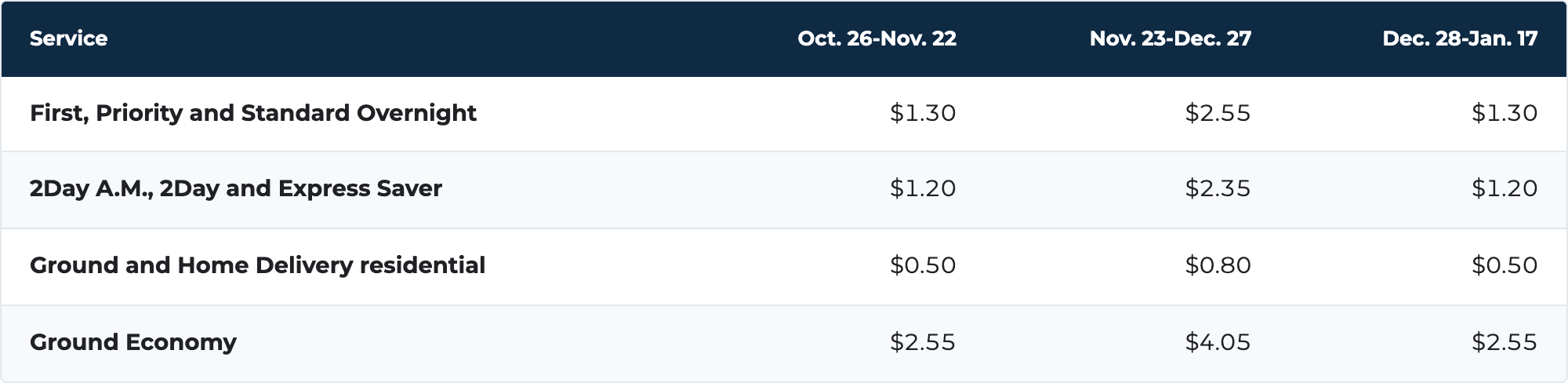
FedEx Peak Season Express, Residential and Ground Economy Surcharges
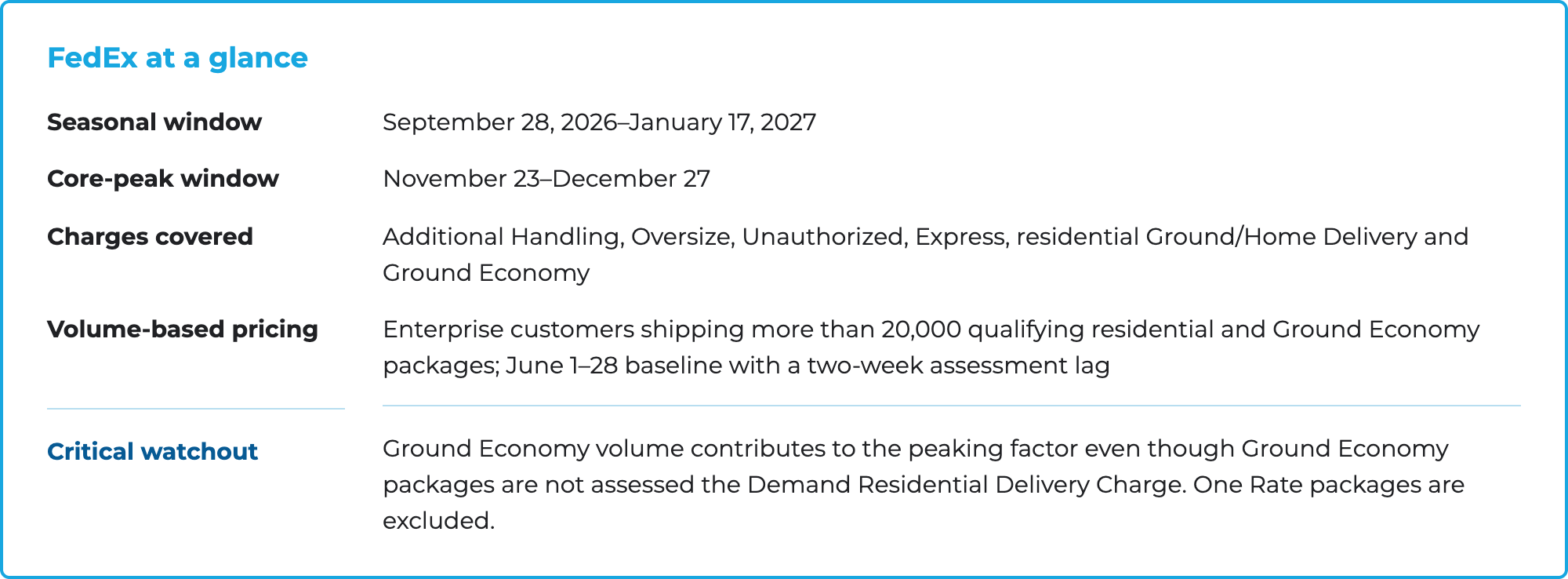
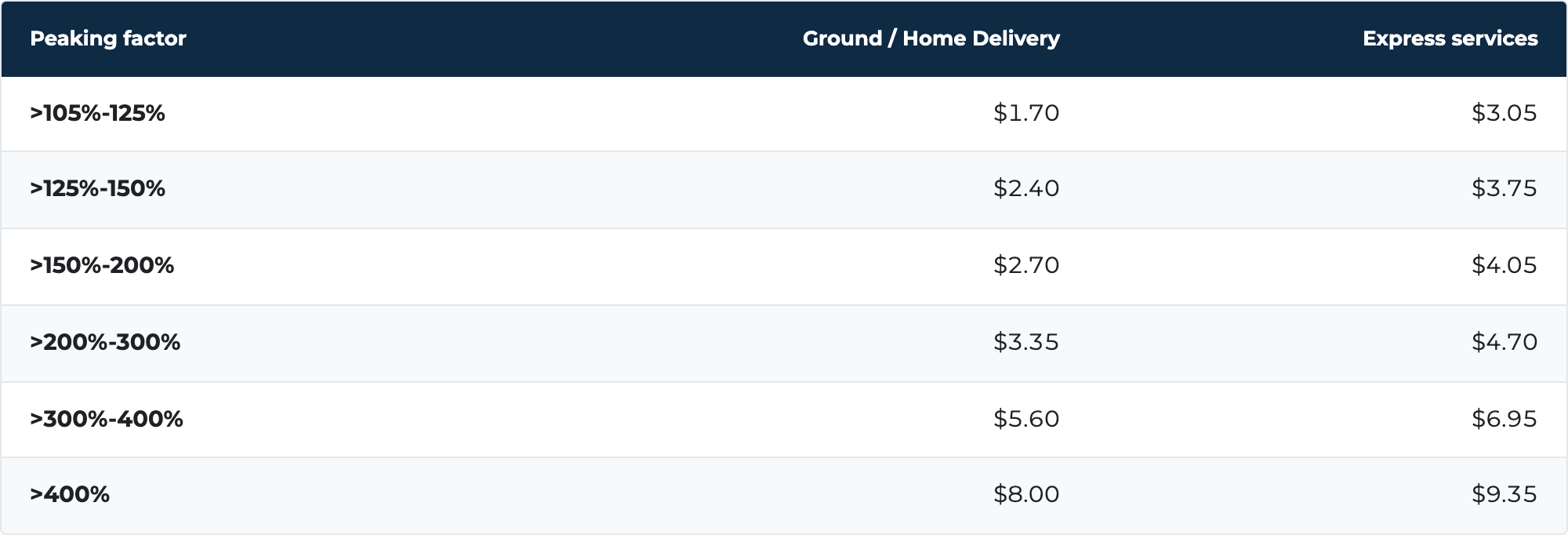
FedEx Volume-Based Demand Residential Delivery Charge
FedEx applies this separate charge to enterprise customers shipping more than 20,000 qualifying residential and Ground Economy packages in a calculation week. The tier is based on weekly qualifying volume relative to a June baseline and is assessed after a two-week lag. FedEx One Rate packages are excluded from both the calculation-week volume and the June baseline. For any calculation week containing a holiday, FedEx adjusts volume for one fewer operating day by multiplying the packages tendered by five and dividing by four.
How Should FedEx Shippers Prepare for Peak Season
- Model Overnight separately from deferred Express. FedEx created distinct demand pricing for those groups in 2026.
- Track weekly residential volume and account for the two-week assessment lag; a promotion can change the tier after the activity occurs.
- Run a package audit for Additional Handling, Oversize and Unauthorized exposure before September 28.
- Review demand protection charge by charge. Ordinary accessorial or residential discounts do not automatically carry over.
04 / UPS Peak Season Demand Surcharges
UPS 2026 Peak Season Domestic Demand Surcharges
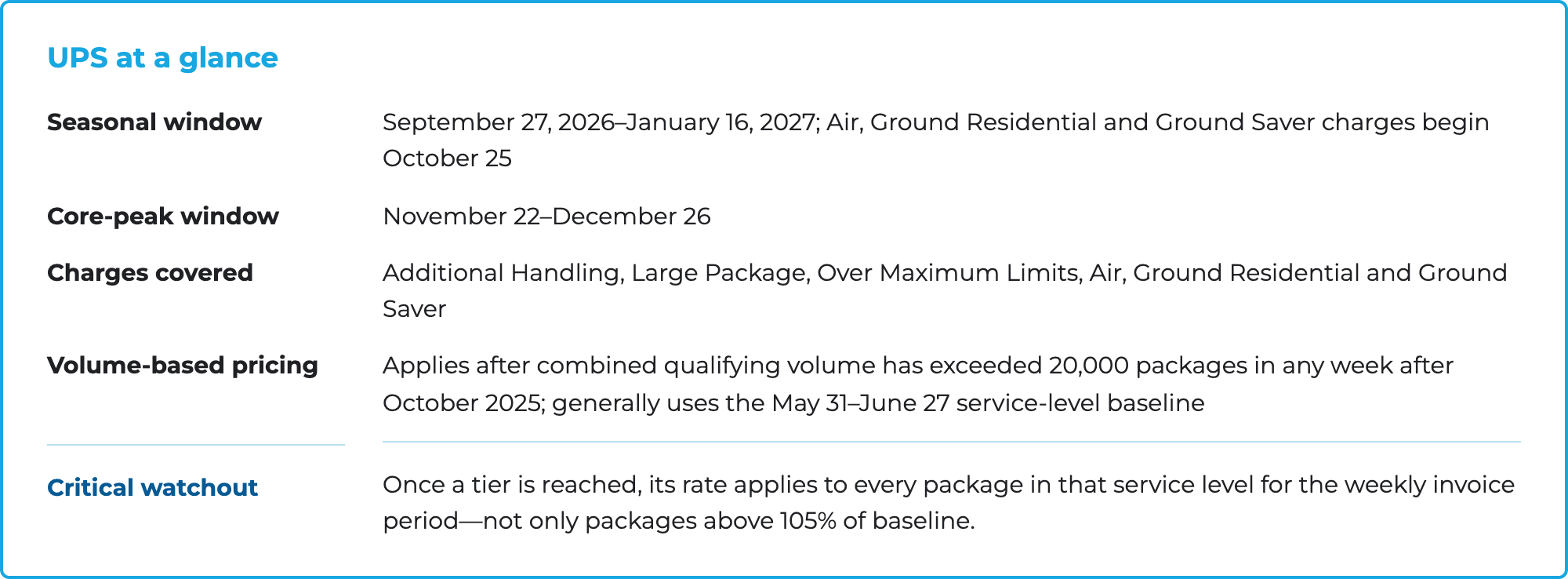

UPS Peak Season Additional Handling, Large Package and Over Maximum Limits Surcharges

These are seasonal add-ons. UPS states that demand surcharges apply in addition to other applicable charges and may apply cumulatively when a package meets more than one specified criterion.
UPS Peak Season Fixed Air, Ground Residential and Ground Saver Surcharges
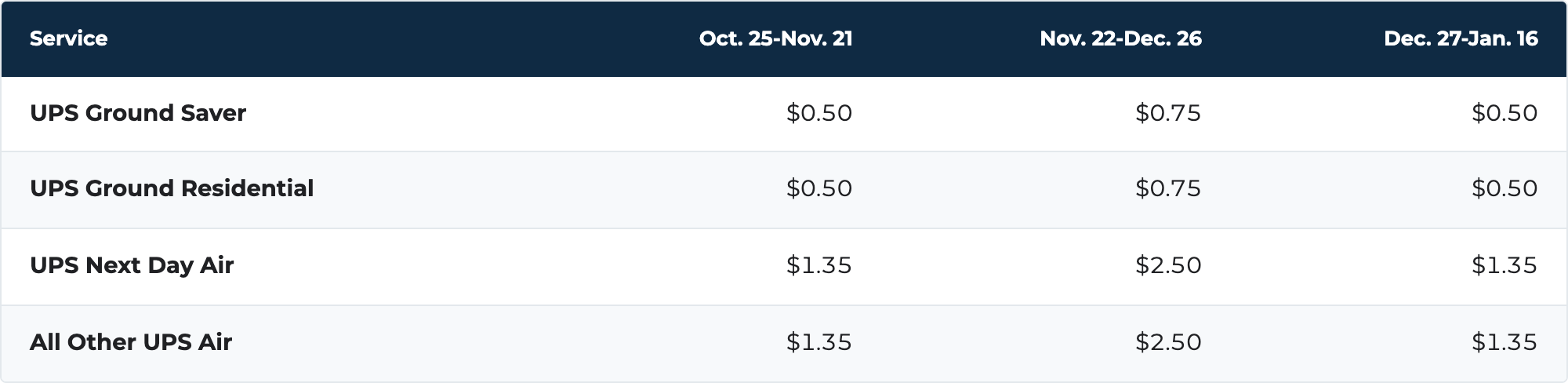
All Other UPS Air includes UPS 2nd Day Air A.M., UPS 2nd Day Air and UPS 3 Day Select. UPS Ground Saver was formerly UPS SurePost.
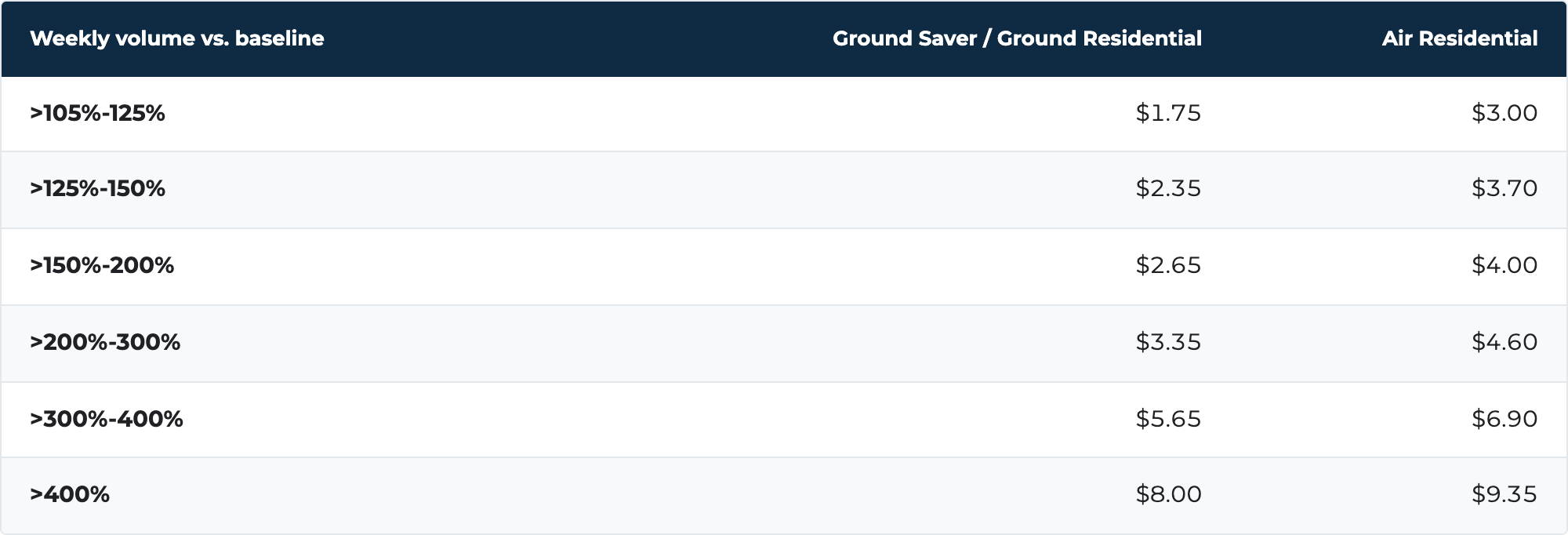
UPS Higher-Volume Residential Surcharge Tiers
The higher-volume schedule applies to customers whose combined qualifying volume has exceeded 20,000 packages in any week after October 2025. UPS generally uses average weekly service-level volume from May 31-June 27, 2026 as the baseline. If the August 30-September 26 average is below 80% of the June average, UPS uses the later, lower baseline.

How Should UPS Shippers Prepare for Peak Season
- Reproduce the June baseline by service level and test whether UPS's August-September substitute will apply.
- Model tier-boundary scenarios. A small weekly forecast error can change the rate applied to the full service-level volume.
- Include qualifying volume across affiliated and related accounts where applicable.
- Request demand-surcharge protection in writing and with specific reference to the charge; do not rely on ordinary accessorial discounts.
05 / USPS Peak Season Demand Surcharges
USPS 2026 Temporary Peak Pricing

USPS Peak Season Retail: Priority Mail and Ground Advantage, Zones 1-4
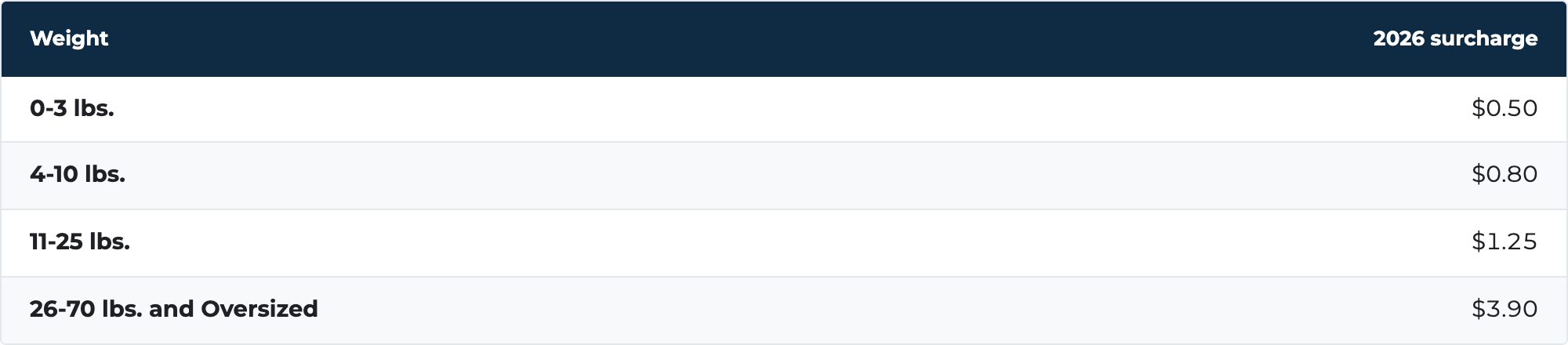
USPS Peak Season Retail: Zones 5-9
USPS Peak Season Retail: Priority Mail Express, Zones 1-9
Retail Flat Rate: Priority Mail Large Flat Rate Boxes $2.10; all other Priority Mail Flat Rate products $1.00; Priority Mail Express Flat Rate Envelopes $2.35.
USPS 2026 / COMMERCIAL RATES
USPS Commercial Temporary Surcharges
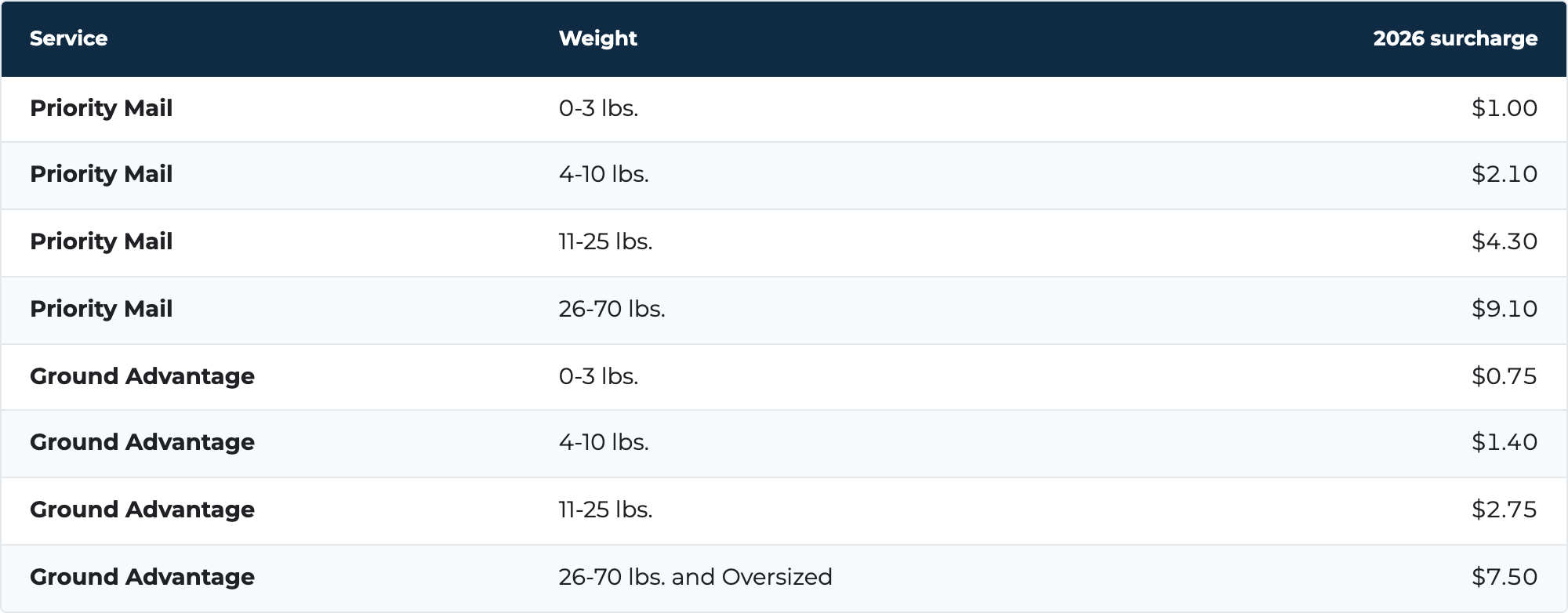
USPS Peak Season Priority Mail and Ground Advantage, Zones 1-4

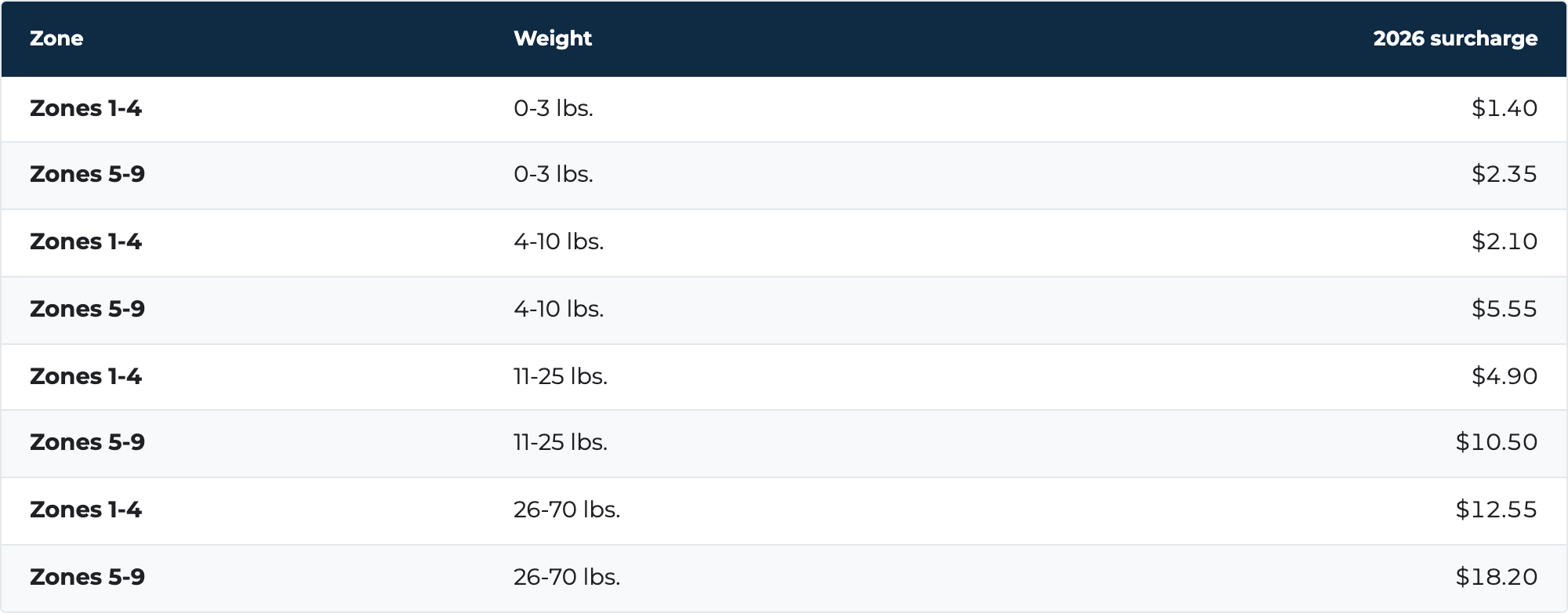
USPS Peak Season Zones 5-9: Priority Mail and Ground Advantage
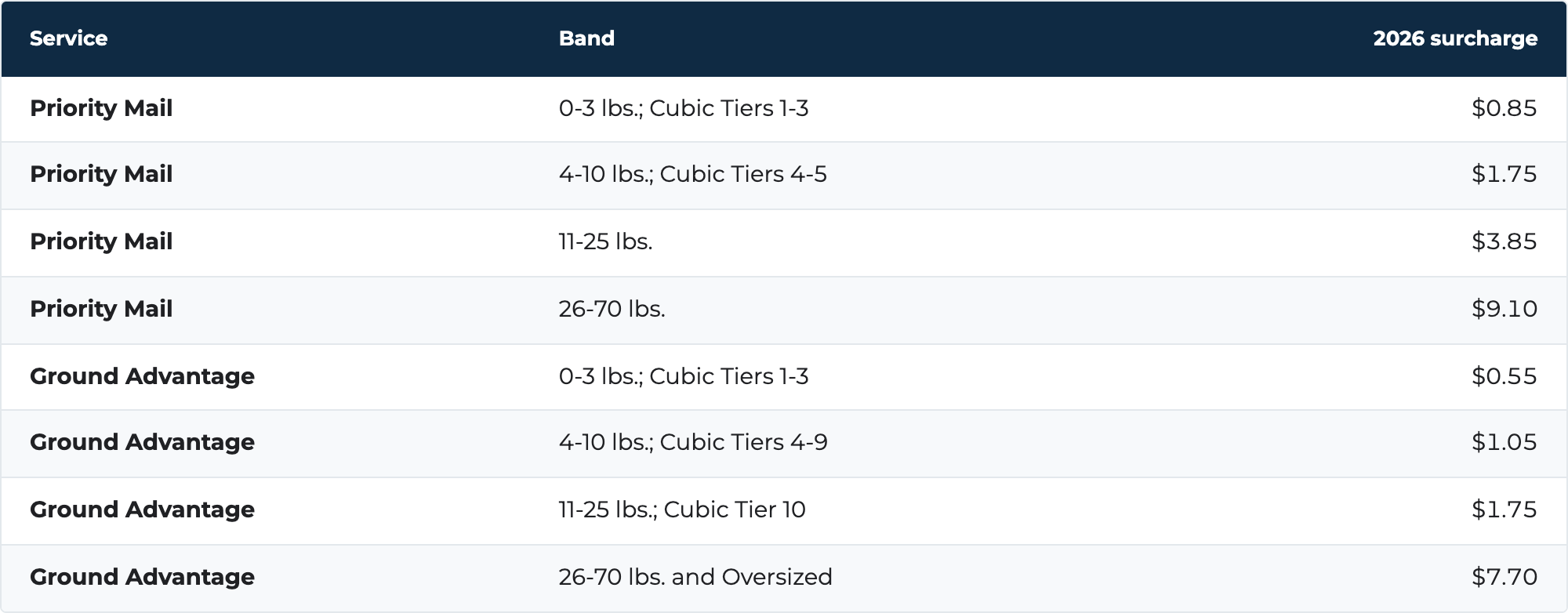
USPS Peak Season Priority Mail Express, Zones 1-9
USPS Peak Season Parcel Select and Commercial Flat Rate
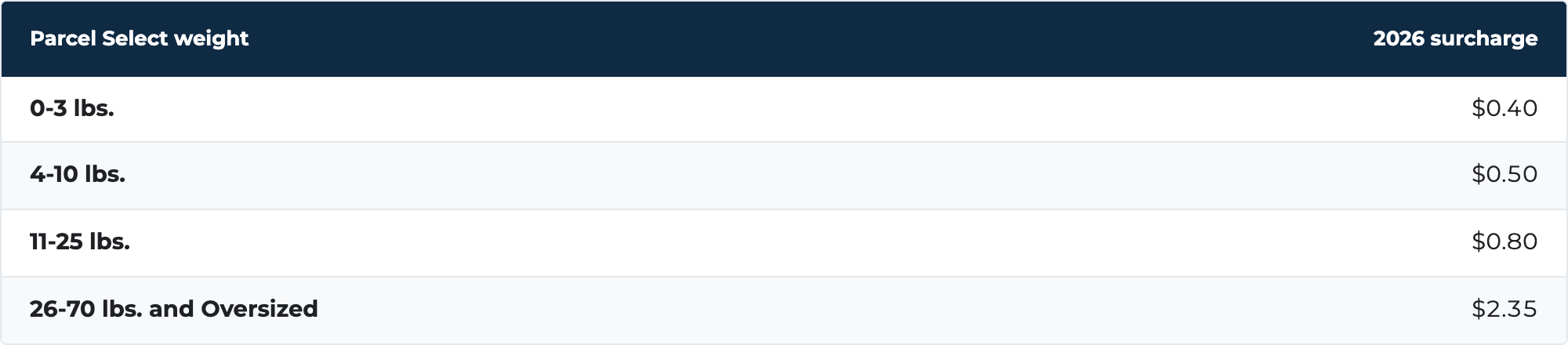
Commercial Flat Rate: Priority Mail Large Flat Rate Boxes $1.75; all other Priority Mail Flat Rate products $0.85; Priority Mail Express Flat Rate Envelopes $2.35.
How Should USPS Shippers Prepare for Peak Season
- Recalculate billed weight with the 139 divisor and rounded-up dimensions. Any pre-July forecast is stale.
- Model weight-band boundaries. A DIM change can increase billed weight and the applicable peak surcharge.
- Evaluate Parcel Select for realistically movable, less time-sensitive volume; its filed increases are materially lower in several bands.
- Confirm how temporary pricing, cubic tiers and base-rate discounts are treated under the agreement.
- Revalidate the filing before October 4. USPS revised its initial schedule during the prior peak cycle.
06 / International Parcel Shipping
International demand and surge fees
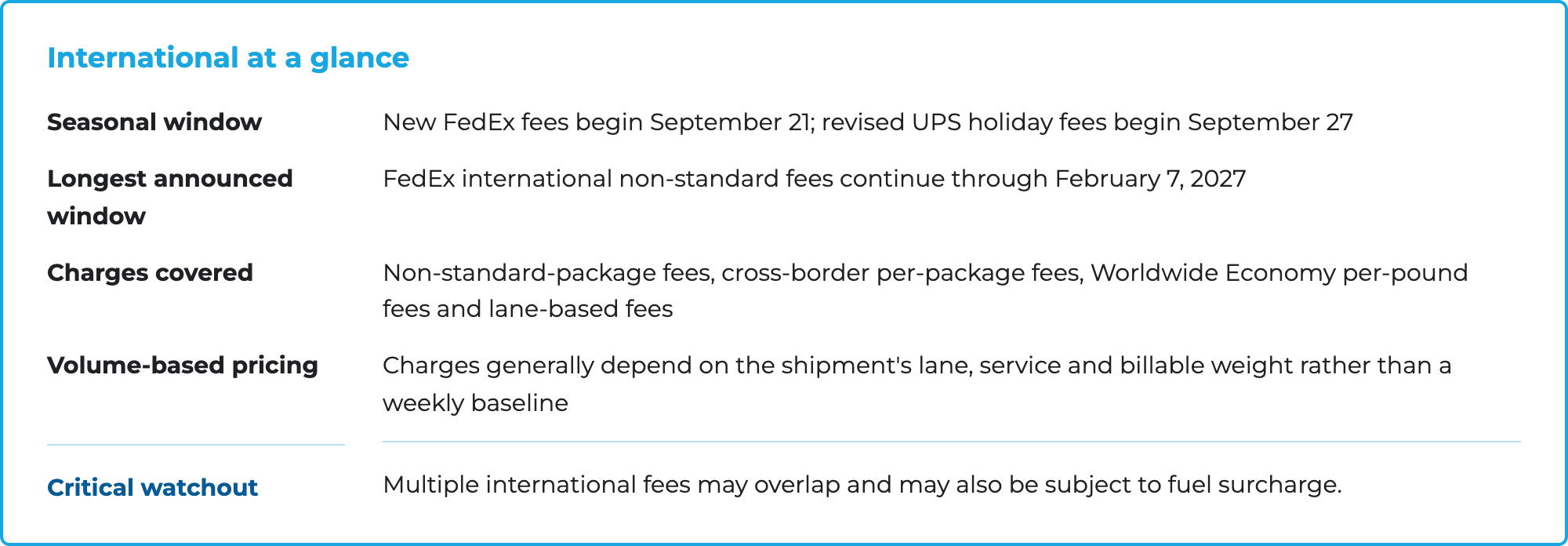
FedEx U.S. international non-standard-package demand fees
From September 21, 2026 through February 7, 2027, FedEx will apply the following demand surcharges to U.S. International Package Services that trigger the corresponding charge. FedEx International Ground is excluded.



UPS international non-standard-package surge fees
For U.S.-origin shipments to all destinations using the listed UPS international services, the following fees apply in addition to the underlying charge.

Covered services include UPS Worldwide Express, UPS Worldwide Express Saver, UPS Worldwide Express Plus, UPS Worldwide Expedited, UPS Worldwide Saver Pallet, UPS Express Freight Time of Day, UPS Transborder Standard and UPS Worldwide Standard.
UPS seasonal cross-border and Worldwide Economy fees

UPS ongoing international lane fees
UPS also lists the following fees as effective until further notice. They are not limited to the holiday window, but they belong in the peak model because they can overlap seasonal charges.
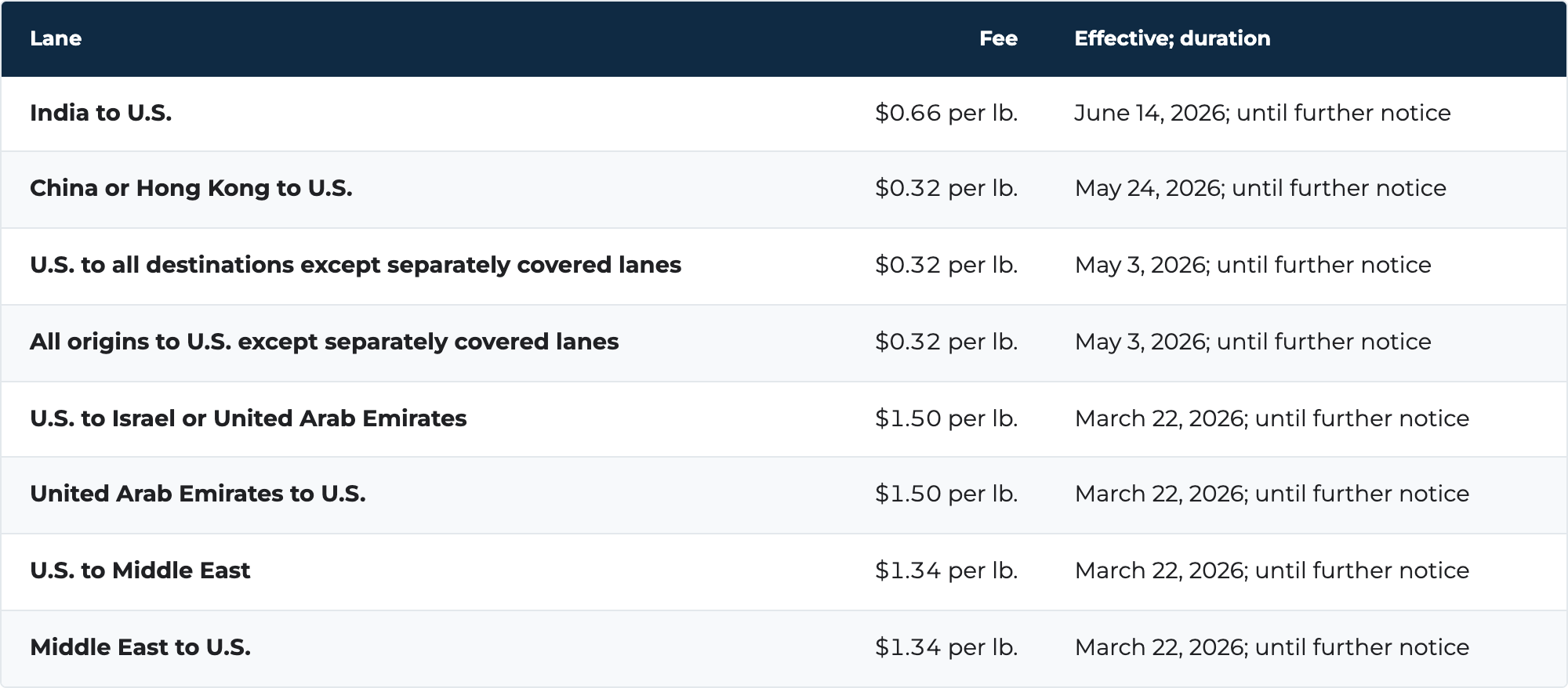
For these fees, UPS defines Middle East as Afghanistan, Bahrain, Bangladesh, Egypt, Iraq, Jordan, Kuwait, Lebanon, Nepal, Oman, Pakistan, Qatar, Saudi Arabia and Sri Lanka.

How Should International Shippers Prepare for Peak Season Demand Surcharges
- Segment historical shipments by origin, destination, import or export direction, international service and billable weight.
- Identify international packages that repeatedly trigger Additional Handling, Oversize, Unauthorized, Large Package or Over Maximum charges.
- Model overlapping UPS seasonal and ongoing lane fees rather than treating each table in isolation.
- Keep FedEx's September update as an open assumption and rerun the model when the additional adjustments are published.
- Continue international invoice audits through February 7, 2027.
07 / Integrating Shipping
Operational Best Practices for Peak Season Shipping
Peak cost controls work best as a cross-functional operating process.
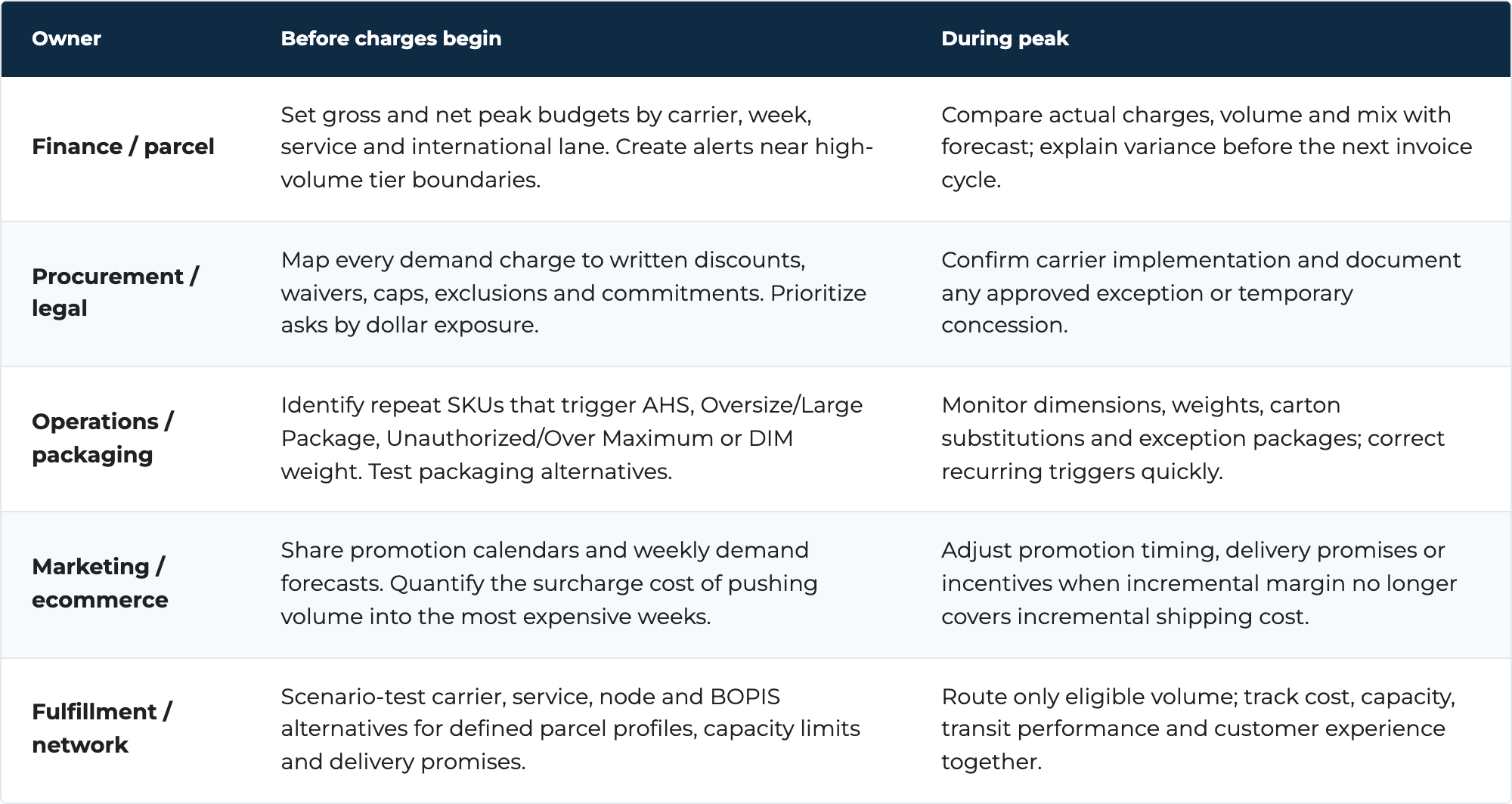
How to Decide When to Make Operational Changes for Better Peak Season Shipping Outcomes
- Packaging: change the box only when the all-in reduction in billed weight and accessorial exposure exceeds material, labor and fulfillment tradeoffs.
- Service shift: evaluate transportation, demand surcharge, transit commitment, capacity and customer promise together.
- Carrier diversification: route by parcel profile and lane economics, not by a broad carrier-average comparison.
- Demand shaping: compare the cost of an earlier promotion or incentive with the avoided peak charge and operational load.
- Negotiation: focus the request on the charges with the largest modeled net exposure and support it with package-level evidence.
08 / Get a Custom 2026 Peak Season Analysis
Get a 2026 Peak Season Cost Impact Analysis
LJM can translate the published schedules into a company-specific peak cost model.
Provide the current carrier agreement and historical shipment data. LJM will:
- Re-rate the historical domestic and international package profile under the 2026 carrier rules;
- Apply existing incentives, waivers, caps and exclusions;
- Identify the services, weeks and package characteristics driving the largest costs;
- Model high-volume and peaking-factor exposure; and
- Flag negotiation targets and operational changes that can reduce cost before or during peak.

REQUEST A FREE PEAK COST IMPACT ANALYSIS
Access This Content
Change the Economics of Your Shipping
Better Rates.
Complete Visibility.
Strategic Edge.


